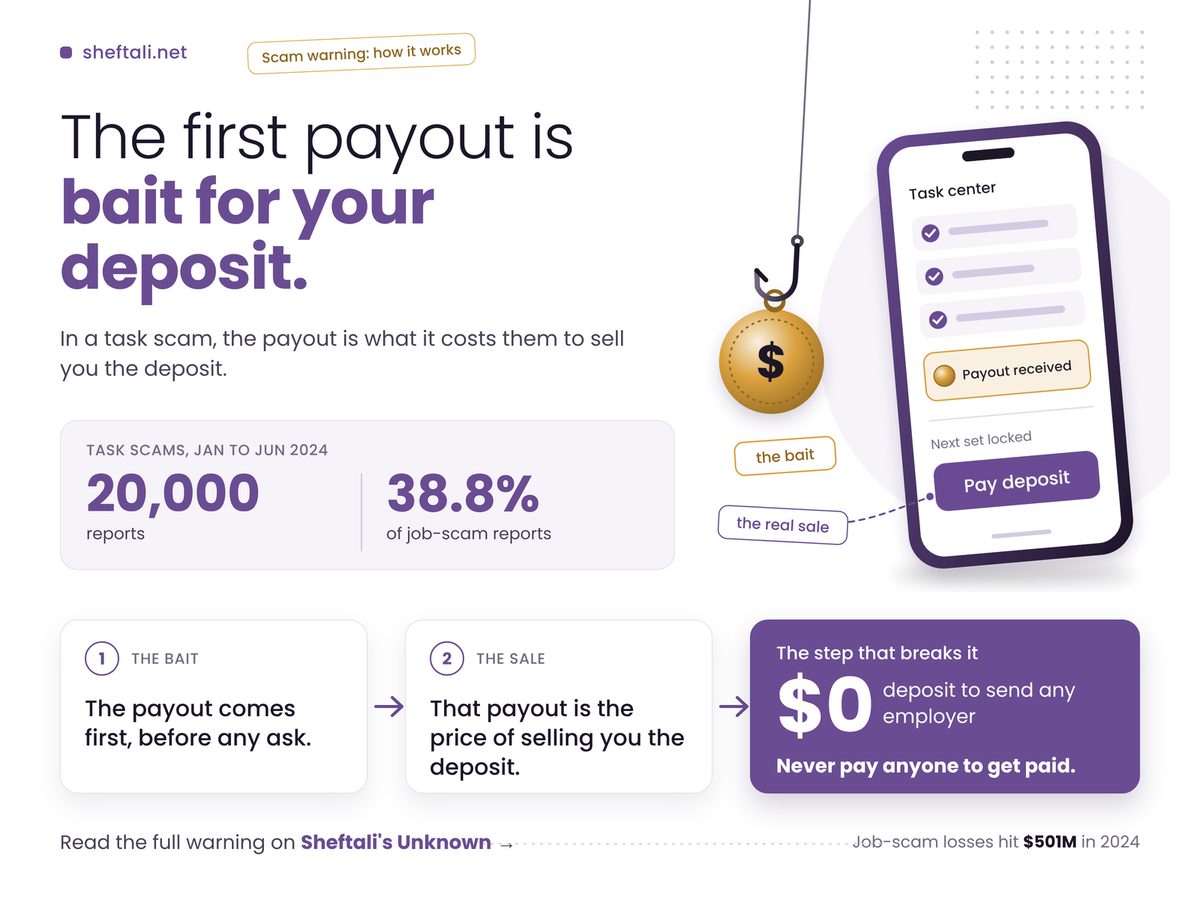
The first payout is real. That is the trick. A task scam pays you a few genuine dollars for clicking through fake "app optimization" or "product boosting" work, so that when the app later asks for a deposit to unlock the next set of tasks, it feels like an advance on money already earned. Think of that payout as the scammer's marketing budget. The deposit is the sale.
Key Takeaways
The early payout is bait: any app that wants a deposit before you can withdraw is a scam, so the first deposit request is where you stop.
- Real employers pay you; none charge you to release wages already earned.
- Small early payouts exist to buy your trust before the crypto request.
- Paid in crypto or by wire, a deposit is very hard to reverse.
- Already paid? Report it to the FTC and your exchange, and ignore paid "recovery" offers.
How do task scams work?
The scheme hires you for fake app work, pays small real amounts for the first easy tasks, then demands your own money, usually crypto, before the next set of tasks or your earnings unlock.
It starts with an unsolicited text or WhatsApp message about online work that names no company you could check. The "job" is tapping a button that supposedly rates products, inside a slick dashboard with a balance and a cheerful "mentor" in the chat. The FTC says paying people to rate or "like" things online is illegal, so the job itself is a red flag before any money moves.
Then the money arrives. Small, real, withdrawable. That payout turns suspicion into a story you tell yourself: they paid me, so they must be paying. The standard advice is to research the company, and I think it is out of date here. These apps borrow real brand names, the same way the safe account scam borrows your bank's real phone number, so a company that checks out tells you nothing about who is messaging you.
Partway through a set, the app says you must top up to finish it, usually in crypto. That payment rail is the giveaway. A March 2025 FTC release found people lost more to scams paid by bank transfer or cryptocurrency than to all other payment methods combined, which is also why a fake dealership website insists on a wire: scammers pick the payment you cannot claw back.
Four FTC numbers, from its December 2024 Data Spotlight and its March 2025 fraud release, show why the damage lands at the deposit stage.
Reports of This Scam, Jan to Jun 2024
20,000
Zero in 2020, routine now
Job-Scam Losses, First Half of 2024
$223 million
Real savings, not pocket change
Time for Crypto Job-Scam Losses to Pass All of 2023
6 months
Crypto sent cannot be pulled back
Fraud Reporters Who Lost Money, 2024
38%
Up from 27%: pitches land more
Spread the half-year loss across the roughly 51,000 job-scam reports implied by the FTC's own share figures, and it comes to about $4,300 per report, counting everyone who lost nothing. That is derived arithmetic, not an FTC statistic, but it prices the deposit stage in thousands, against the handful the app paid you first.
Half a year of 2024 was enough for crypto job-scam losses to pass all of 2023. Each of those dollars left as a deposit with no chargeback button.
A polished app settles nothing. What matters is which stage of the script you are in.
Why do I have to deposit money to unlock tasks?
You are asked to deposit because the deposit is the scam's only product: the tasks are fake, the balance is a number on a screen, and every early payout existed to make this one request feel safe.
Here is a one-minute check. Add up every dollar the app has actually paid into your bank, not the balance it displays, and put the deposit it wants beside that total. If the deposit is bigger, and sooner or later it must be or the scheme loses money, you are funding your own wages plus the scammer's margin. Call it the payout test. Then find your stage below and read across.
| If you | Do this | Because |
|---|---|---|
| 🧾 Got a payout | Total it before doing more | Early payouts buy trust, not wages |
| 💰 Told to deposit | Stop; send $0 to any employer | FTC: deposited money is not recoverable |
| ⏱ New set offered | Quit before the next 40 tasks | Deposit demands arrive between sets |
| 🔒 Crypto sent | Report to the FTC and your exchange | Paid recovery offers are a second scam |
| 📊 Job text | Ignore it unless you applied | Job-scam losses hit $501M in 2024 |
No row says "finish the set first." That urge to win back your money is the lever the next deposit pulls.
Treat any unexpected text offering easy online work as this scheme until it proves otherwise, because by mid-2024 nearly two in five job-scam reports followed this exact script. Source: FTC Data Spotlight on task scams, December 2024; the full grey bar is all job-scam reports.
Can I get my money back?
Usually not: crypto sent to a scammer has no chargeback, so recovery depends on reporting it fast and on ignoring anyone who later offers to get it back for a fee.
Your exchange may freeze a receiving account if you tell it quickly, but nobody can promise a reversal. Report at ReportFraud.ftc.gov and the FBI's IC3 site anyway. The scheme needs you to answer at all, the same opening move as the toll text that asks you to reply Y.
The second wave is the dangerous one. Lose money once and "recovery agents" offering to trace your coins for an upfront fee start calling, running the same play twice, like the refund trap inside the renewal invoice scam. The pool keeps growing: the FTC told Congress in March 2026 that consumers reported $15.9 billion in fraud losses across 3 million reports in 2025, so anyone who paid once should expect a follow-up pitch. Here's the grey area, in my opinion: the platforms that turn a victim's cash into crypto should share that loss, and whether they ever will is an open question, probably a long one.
- A balance that grows but cannot be withdrawn without a "fee" or "tax".
- An instruction to move the chat from text to WhatsApp or Telegram.
- A recovery service that contacts you first and wants payment upfront.
- Any request to pay in crypto or through a crypto ATM.
Check these against your own chat
- The first contact came from a number you never gave an employer.
- You cannot name anyone at a company with a listed phone number.
- The app shows a balance you have never moved into your own bank.
- The next step costs you money before you can be paid.
One yes is enough to treat the chat as hostile.
The payout comes first because it is the cost of selling you the deposit, so the one rule that breaks the whole scheme is to never pay anyone to get paid. This week, before you open that app again, total what it has truly paid into your bank, send nothing more, and file the chat at ReportFraud.ftc.gov.
No comments
Post a Comment