A fake dealership website does not look cheap or sloppy. It looks exactly like a real dealer's, because it was copied from one, down to the logo and the inventory pages. Then it adds one rule the original never had: pay by wire, and pay before you see the car.
TL;DR: A seller who takes only a wire and will not let you inspect the car is the scam, however real the website looks.
- Logos and photos prove nothing, because scammers now copy them from real dealers.
- The payment request is the tell: never wire money before you have seen the car.
- Verify through a phone number you found yourself, and ask for an in-person or mobile inspection.
- If you already wired, call your bank the same day and ask for a recall.
Why does a fake dealership website insist on a wire?
Because a wire is the one payment you cannot pull back on your own, and a site copied from a real dealer cannot keep your money if you pay any way that can be reversed.
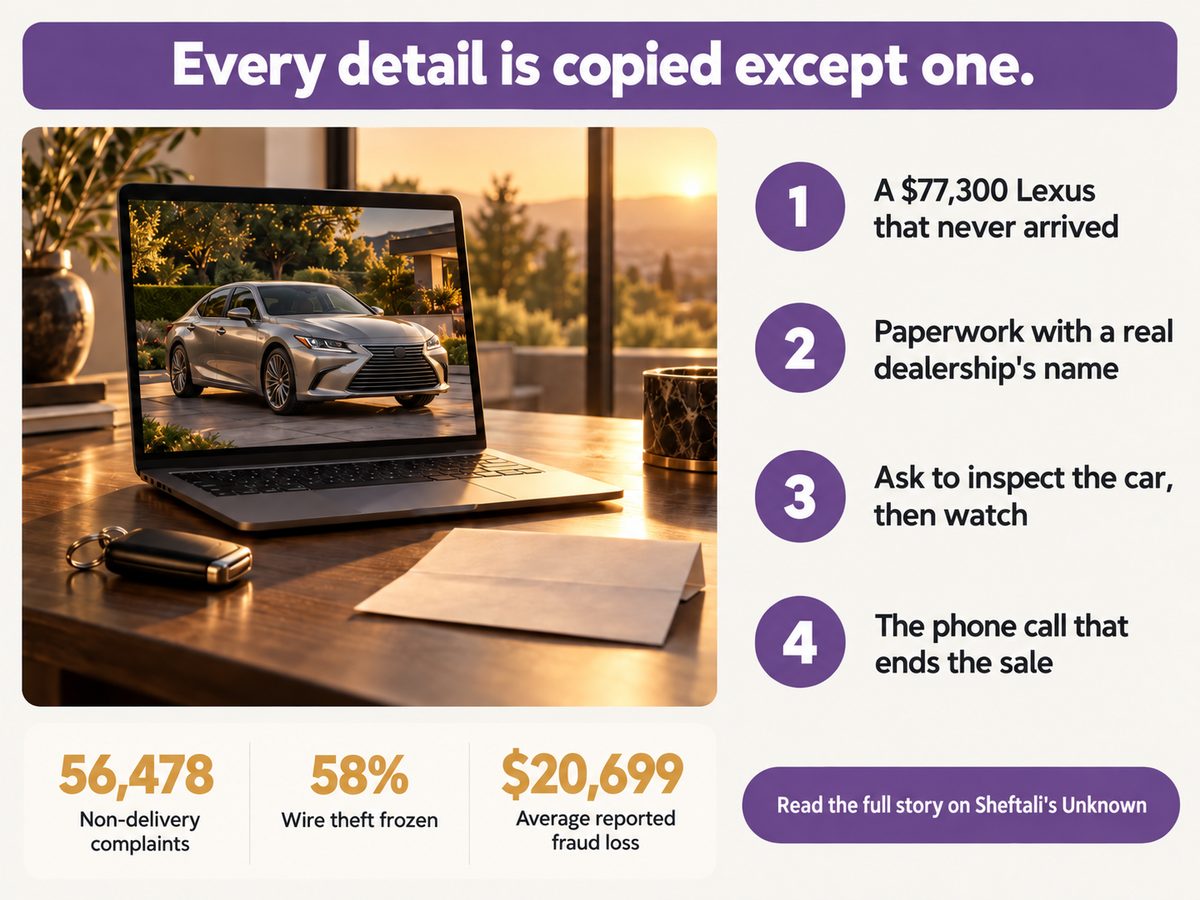
A September 2026 FTC consumer alert lays out the method. Scammers use AI to copy a real dealer's site, logos and listings right down to the photos. They advertise rare or classic cars with a normal-looking process and flexible returns, then demand an upfront wire transfer. The car never arrives, and the sale is never recorded at the real dealer. Every trust signal on the page is now a copy, so the only thing left to test is what you are asked to do with your money.
So the old advice to hunt for typos or blurry photos is outdated. Those tells belonged to scams written by hand, and a cloned page has none. Real sellers are also expected to disclose terms before money moves, which is the logic behind what auto-renewal law requires a company to show you before it bills you. A clone owes you no such disclosure, and its only real term is how you pay.
A page that seems to know what you want proves little, since personalised offers are routine (see how your personal data sets your price). Four figures, from the FTC's 2026 imposter-scam data spotlight, the FBI's 2025 Internet Crime Report and a TheStreet report of 28 September, show how much can go wrong before you notice.
Chat Before Payment
About 10 days
Friendliness is not verification
Sent For One Lexus
$77,300
Real name, wrong seller
Non-Delivery Complaints, 2025
56,478
You would not be the first
Imposter-Scam Losses, Year On Year
Up about 20%
Copying trusted brands pays
The slow build matters more than the total. Each reply and each scanned document makes stopping feel rude, and politeness is the cost a scammer wants you to weigh against a large sum. In the reported case the dealership named as payee was genuine and had nothing to do with the sale.
A cloned site can copy everything a dealer owns except the one thing a buyer controls: how the money moves.
How do you verify a car dealer online before paying?
Check how you are asked to pay, which number you call and whether the seller allows an inspection, because a page can copy everything else and none of those three depends on how it looks. The table sets a real dealer against a cloned site, money first, because the loss happens there.
| Dimension | Real dealer vs cloned site | What it means for you |
|---|---|---|
| 💰 Payment route | Real card or bank loan Clone wire only, paid first |
❌ A wire is the one route you cannot dispute |
| 🧾 Deposit ask | Real hold on a signed order Clone 100% of price up front |
❌ You carry the whole price on day one |
| 📊 The listing | Real stock you can price-check Clone rare or classic car |
⚠️ A rarity is hard to price-check |
| 🔒 Contact route | Real number you found Clone number on the page |
✅ 1 call you place settles it |
| 🛠 Inspection | Real in person or mobile Clone refuses or stalls |
✅ 1 refusal ends it at no cost |
| ⏱ After you pay | Card dispute with the bank Wire recall on day 1 |
⚠️ Each day of delay costs you odds |
| 🏁 Best suited for | Real a car you can inspect Clone nobody, walk away |
🏁 Pay only after you have seen it |
My own arithmetic, not a citation: the FBI's $503 million in non-delivery losses spread over its complaints works out to about $8,900 each, so the Lexus wire was roughly 8.7 times a typical paid-and-never-delivered loss and nearly four times the $20,699 average across all complaints. A car deposit belongs in a different risk class from an online order and deserves a different level of checking.
If you wire money to a scammer, call the sending bank the same day and ask for a recall, because in the cases that reached the FBI's bank channel, more than half of the attempted money was frozen. Source: FBI IC3 2025 Annual Report, Financial Fraud Kill Chain, 3,900 incidents; the frozen share is $679,013,183 of $1,163,919,846, and victims outside that channel are not counted.
What if you already wired the money?
Call the bank that sent the wire the same day and ask for a recall, then file a report at ReportFraud.ftc.gov and with the FBI's IC3, because speed is the one lever you still hold.
Recovery is possible, not promised. The FBI's figures above cover only incidents that reached its bank channel, so read them as a reason to call fast, not as odds for your own case. TheStreet's account of the Lexus wire does not say whether any money came back, and I would not assume it did.
Scam exchanges can involve links and attachments, so keep your banking computer patched, and read what extended Windows 10 support to October 2027 covers if yours is still on it.
One grey area, and this is opinion, not finding: a dealership that really exists proves less than buyers think. Treat its name on your paperwork as a reason to phone it, never to relax.
- A return policy is a promise from the seller, so it is worth exactly as much as the seller.
- A real dealer's name on your paperwork proves the name exists, not that the bank account is theirs.
- Search the dealer's name plus scam or complaint before any money moves.
Walk away if any of these is true for you
- You cannot see the car, in person or through an inspector you chose.
- The only phone number you have came from the site or a text message.
- The wire details arrived by message and nobody at the dealership has confirmed them by phone.
- You are asked to send the money before anything is signed.
The decision is simple: pay only for a car you have seen, or had inspected by someone you chose. This week, and every time after, call the dealership on a number you found yourself, ask whether that car is theirs, and send no wire until it is.
Related: the safe account scam, where a caller showing your bank's real number asks you to move money