The standard advice is to cancel whatever you have stopped watching. Try it on a streaming service and watch where it breaks: you click cancel, and instead of leaving you are handed a cheaper plan, a free month, or a tier you did not know existed. Streaming retention offers are the reason a decision to leave so often ends with you still subscribed, paying less, and watching a service that now earns more from you than before.
What Are Streaming Retention Offers?
They are discounts, free months or a cheaper advertising tier presented at the moment you try to leave, rather than at renewal when you are deciding whether the service is worth its price at all.
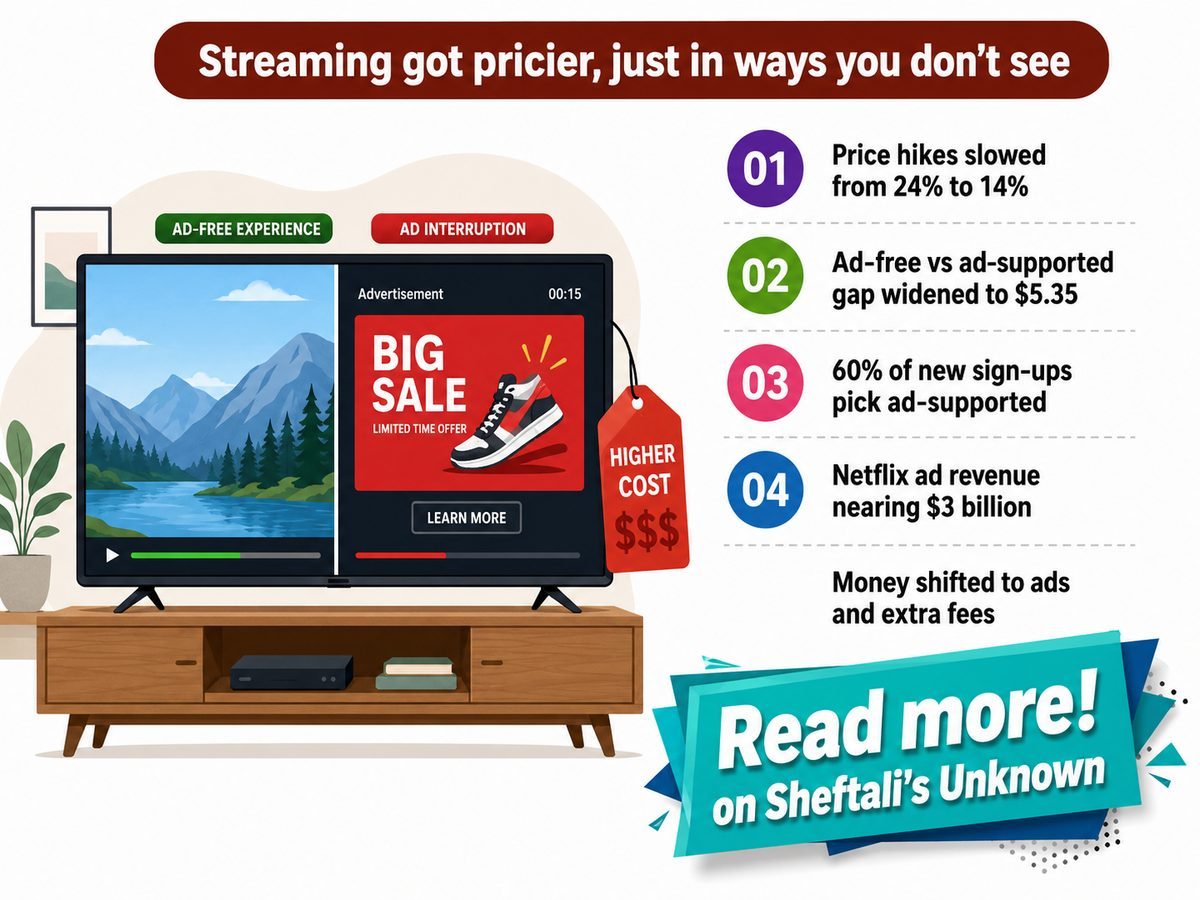
Ampere Analysis published a three year pricing dataset in August 2026 covering Netflix, Disney+ and Amazon. The average annual price increase fell from 24 per cent in 2023/24 to 14 per cent in 2025/26. Two years, and the size of the ask nearly halved. Most coverage read that as competition finally working.
I would argue the opposite. Nothing about this market got more competitive. Households started cancelling, and a cancellation is worth far less to a streamer than a downgrade, so the industry built a downgrade worth having and made it the cheap answer to a question it asks you at the door. The price stops being a number on a rate card and becomes a function of what you will tolerate, which is the same mechanism behind the way your own data quietly sets the price you are shown.
Ad-Free Premium
$11 a month
Netflix US, was $8.50
Tier Gap Now
$5.35
Widened from $4.53
Ad Tier Reach
250 million
Monthly active viewers
Sign-Up Share
60%
Choose ads where offered
A company that shows you a better price only when you threaten to leave has been charging you the worse one on purpose.
Why The Cheaper Tier Only Appears At The Exit
Because a customer who never asks is worth the full price, and one who reaches the cancel screen has just told the company exactly how much they were about to stop paying, which is the only number a retention offer has to beat.
Advertising is what makes the offer affordable. Ad inventory scales with viewing hours rather than billing events, so a household that downgrades and keeps watching can be worth more than one paying more and watching less. Netflix advertising was tracking near three billion dollars during 2026, roughly double the previous year. Charging for extra member slots after the password sharing crackdown adds a second meter, pointed at people who were already inside the account.
Jaanika Juntson of Ampere Analysis put the mechanism plainly when the data landed: advertising has become an increasingly important revenue stream that reduces reliance on subscription pricing alone, while password sharing crackdowns let streamers get more value out of the audience they already have. Read that twice. None of it is about giving anybody a better deal, and it is the same quiet transfer as hardware you already paid for turning into a subscription.
Does Downgrading Actually Save You Money?
Sometimes, and the way to tell is to price the gap rather than the plan, because the number that moved over the past three years is the distance between the two tiers rather than either tier on its own.
| What To Price | The Number | What It Tells You |
|---|---|---|
| Ad-Free Premium | About $132 a year in the US | What silence is costing you |
| Average Increase | $1.60, about 17% of the prior price | Slower is not the same as small |
| Netflix | $1.73 average rise, 16% of prior price | Biggest dollars, tightest percentage |
| Disney+ | 31% of prior price, down to 13% | Steepest deceleration tracked |
| Amazon | $1.47 average rise, but 30% of prior price | A low base inflates fastest |
| Extra Member | Billed and renewed separately | Easy to forget, easy to keep charging |
Work down that middle column and the shape separates from the headline. Every service level figure describes a slowing rate of increase on a plan price. Not one describes the thing that actually grew, which is the distance between the two plans you are asked to choose between. That distance is the product now, and it widens even in a year when neither headline price moves.
Region matters more than the averages suggest. Ampere put North American subscribers at $1.70 an increase, about 15 per cent of the prior price, Western Europe at $1.86 and 16 per cent, and Central and Eastern Europe at $1.68 and 18 per cent, the steepest proportion of any region measured. Same companies, same three years, and the share of your old bill being added varies by where you happen to live. None of that appears on a rate card, and none of it is something a subscriber gets to negotiate, which is worth holding in mind before reading any retention offer as generosity.
What We Are Not Able To Measure
Nobody publishes how many minutes of advertising an hour each tier carries, or how that has moved since these plans launched, which means the thing most likely to erode the value of a downgrade is the one nobody can put a number against.
I will flag that as my read rather than a finding. Ad load is not contractually fixed. A plan carrying four minutes an hour today can carry seven in eighteen months with no price change, no notification email and nothing a comparison site would record as an increase. An annual plan locks the price and does not lock what the price buys. We also do not cover Indian pricing on these services in this piece, because the tier structures differ enough that the dollar figures above would mislead. A claim you cannot check is the common thread here, the same reason a fake spare part goes unnoticed at a repair counter, and the reason a family plan can quietly cost more than it saves.
Key Takeaways
- The better price usually exists months before the cancel screen shows it to you.
- Price the gap between the two tiers, not the plan. The gap is where the increase moved.
- An annual plan locks what you pay and not the advertising you will sit through.
- Extra member slots bill separately, so audit them the same day you audit the main plan.
Open your account settings tonight and find what the ad-free option costs you above the advertising plan. If that gap is larger than you would have accepted as a straight price rise, you already took the increase. You took it as a choice, which is exactly why it was arranged that way. Start the cancellation flow before you decide anything, look at what appears, and then close the tab and think about it for a day. The offer will still be there tomorrow, because it was always available.
No comments
Post a Comment