Your child spikes a fever at eleven at night. You open a retail app, type in baby thermometer, and the first page hands you the expensive ones. Not because they rank better. Because something in the profile attached to your account has decided you are a new parent, awake late, in no position to shop around. The Federal Trade Commission used almost exactly that scenario as its own illustration, which tells you it is not hypothetical.
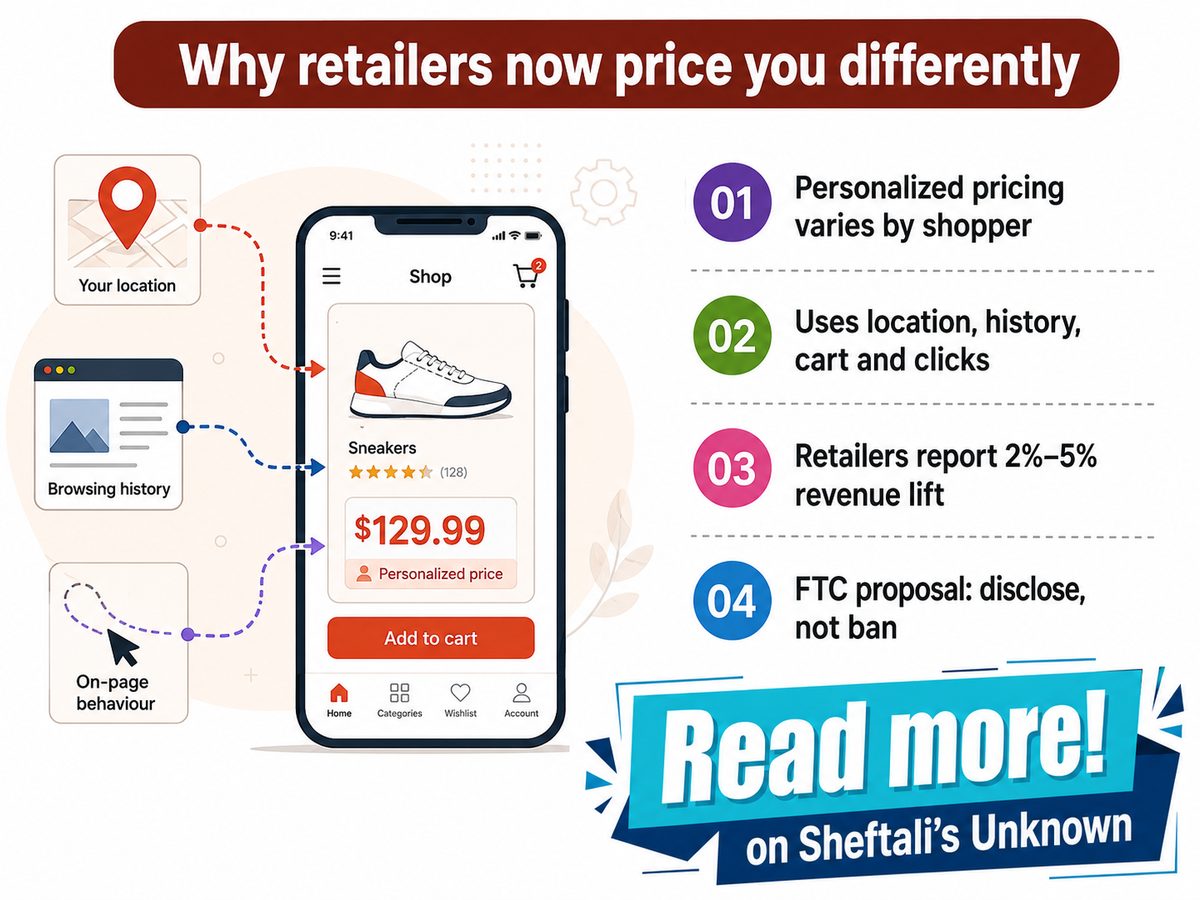
Why It Matters
Start with the distinction the whole thing turns on. Dynamic pricing moves with supply, demand and inventory, and it hits everyone in the market at the same moment. Personalized pricing moves with you. The same product on the same page can carry a different number for you than for the person sitting next to you, because the retailer has built an estimate of what you specifically will tolerate. The first is economics. The second is a guess about your wallet, assembled from data you did not knowingly hand over for that purpose.
And here is the part most of the coverage underplays: the money is not the real injury. A few percent on a thermometer will not ruin anyone. The injury is that you cannot detect it. A shortage you can read about. A surge price announces itself in the checkout screen. A price built quietly from your browsing history looks exactly like an ordinary price tag, which is precisely why it works.
A January 2025 Federal Trade Commission study of six pricing intermediaries, Mastercard and McKinsey among them, documented what actually feeds these systems: precise location, browser and search history, cart abandonment, demographics, purchase history, and mouse movements on the page. Mouse movements. The hesitation before you click is an input. It is the same shape as a vendor rewriting the deal after you have already paid, the pattern behind cloud shutdowns bricking smart home devices you already own, except this one happens before the sale instead of after it.
Four figures explain the shape of the problem better than any argument about fairness does. One is a deadline. One measures who absorbs it hardest. One is scale. One is the reason the industry will fight for it.
Comment Window Closes
18 Sep 2026
Thirty days from proposal
Food Share Of Income
33%
Lower income households, pretax
Retail Clients Reached
250+
Through studied pricing intermediaries
Reported Revenue Lift
2% to 5%
Where personalization is deployed
Take the client reach figure. That is what separates this from a story about two or three technology giants running clever experiments on their own customers. These pricing engines are sold as a service, bolted onto grocery chains and apparel retailers that have never written a line of machine learning in their lives. Your local supermarket does not need a data science team to price you individually. It needs a vendor contract.
A low single digit revenue lift is not a rounding error at retail scale. It is the entire reason no chain gives this up until a regulator makes it.
What The Proposal Actually Says
So what does it require, and where does it stop? Here is the whole of it, stripped of the compliance language the law firm client alerts are written in.
| Category | Detail | Insight |
|---|---|---|
| Status | Proposed enforcement policy under docket FTC-2026-1057, not legislation | Guidance with Section 5 teeth behind it |
| Disclosure | Three elements required: personalization stated, its basis, the data types | All three, or the disclosure fails |
| Wording | Vague framing such as "specially selected" ruled insufficient | Euphemism will not clear the bar |
| Data In Scope | Seven categories named, from precise location to on-page mouse movement | Behaviour you never priced yourself against |
| Exempt | Market-wide dynamic pricing carries no disclosure duty at all | Surge pricing stays as invisible as before |
| Safe Harbour | One logged-in account's own prior purchases, disclosed accurately and completely | Loyalty history is the sanctioned pricing input |
| Highest Risk | Health status, family circumstance or absence of alternatives as inputs | Vulnerability targeting draws the first enforcement |
| Margin Effect | Adopters report profit margin gains of 1% to 4% | Nobody abandons this without external pressure |
Read the safe harbour row twice. If a retailer prices you off your own purchase history on your own logged-in account, and says so plainly, it is compliant. That description covers a very large share of what grocery loyalty programmes already do today, which means the practice most shoppers would object to hardest is also the one most cleanly blessed.
Three stages in the arc: eight pricing firms were ordered to hand over records in July 2024, the enforcement policy went out for public comment in August 2026, and the disclosure duty is expected to take practical effect in 2027.
Friction Points
The proposal does not ban any of this. It cannot, or rather the FTC says it cannot, reading its own authority as reaching disclosure and stopping there. Chairman Andrew Ferguson framed the expectation plainly: when consumers see a listed price, they expect it to be the same price that everyone else sees, not the retailer's estimate of how much they are willing to pay based on their personal data. That is an accurate description of what shoppers assume. It is not a description of what the policy delivers.
Here is where I part company with the optimistic reading. A disclosure tells you a price was personalized. It does not tell you whether yours is the high one. Without a baseline, without the unpersonalized number sitting beside it for comparison, the label is a weather warning with no temperature attached. My honest view is that this is the unsolved weak point, and the comment docket will not solve it either, because the obvious fix, publishing a reference price alongside the personal one, is the single thing retailers will refuse outright.
None of this is unusual for how consumer terms get rewritten on people quietly. It is the same posture as the way Windows 10 extended security update terms landed without an announcement, changed in place, visible only to whoever went looking. What you can control is your own measurement discipline. Four things are worth watching:
- Signed in versus signed out. If you only ever see the app's logged-in price, you have never seen the other one.
- Loyalty cards. The discount is real. So is the profile it builds while you collect it.
- Location permissions. Precise location sits on the FTC's list of pricing inputs, and most retail apps request it by default.
- Repeat visits. Cart abandonment is a documented input, so hesitating on a product page is itself a signal you are sending.
Key Takeaways
- Consumer Reports found Instacart running live price experiments on shoppers who were never told they were part of one.
- Kroger sorts loyalty members into buckets such as loyal and non-loyal, and those buckets are pricing inputs, not just mailing lists.
- A price checked while signed in and the same price checked in a private window are two separate measurements. Treat them that way.
Do one thing this week. Pick something you buy on a schedule, check its price signed in on the app, then check it again in a private browser window with location switched off, and write both numbers down. If they match, good, you have a baseline. If they do not, you have learned more about how you are priced than any disclosure label is ever going to tell you. Start measuring now, while the comparison still surprises you.
Related: the auto-renewal law now requires clearer consent before your card is billed again
No comments
Post a Comment