Here is the mechanism, not the sob story. You sign up for a trial or a first-year rate, hand a card number over once, and the company bills that same card on the same date every year until you notice and stop it. No reminder call, no requirement to warn you first, unless the state you're billed from has passed an auto-renewal law that says otherwise. Most of the country still runs on the old default: silence counts as agreement.
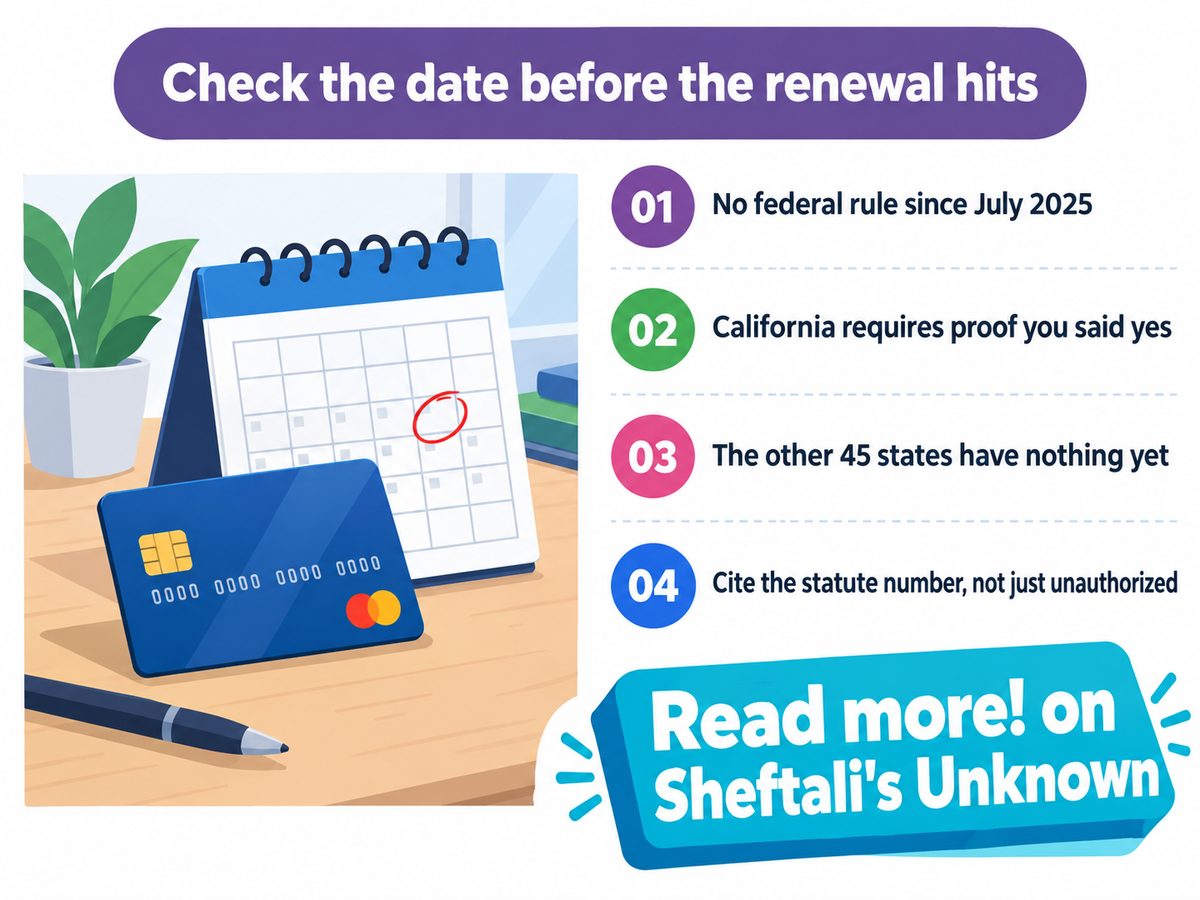
That changed unevenly. A federal rule meant to make cancellation as easy as sign-up got struck down in July 2025 over a skipped cost study, not the substance. What's left is a patchwork, state by state, deciding what you are owed before the next charge hits.
No federal click-to-cancel rule exists right now, so protection depends on your billing state's own renewal law.
- California has required upfront disclosure and a separate renewal consent since July 2025.
- Maryland, Colorado, Maine and Connecticut each add a different 2026 protection, from cancel links to banned phone pitches.
- A federal appeals court vacated the FTC's rule on a technicality in 2025, not on the merits.
- Match your billing state's effective date before you dispute any renewal charge.
What does an auto-renewal law actually require before you're charged?
These laws usually require clear disclosure of the renewal terms before you agree, a separate opt-in in some states, and a working one-click cancel path in a few.
Streaming services already shifted real cost increases into ad tiers and extra-member fees instead of raising the sticker price, and what a retailer knows about you can quietly set the price you are quoted. This law is the backend version of the same fight: not what you are charged, but whether you were ever told the charge was coming back.
California set the pattern other states are copying. Since July 1, 2025, any company billing a California resident must show renewal terms clearly before the sale closes and get an explicit yes, not a pre-checked box (Cal. Bus. & Prof. Code §17602(a)(1), via Purchy, 2026). It must also keep proof of consent for three years, so a disputed charge puts the burden on the company, not the customer. Four numbers below make the size of this fight concrete, from Purchy's 2026 tracker and WilmerHale's 2025 analysis.
How Long CA Must Keep Consent Proof
3 years
Not just their word
State Deadlines Live by Mid-2026
5 states
Check your own first
Estimated Provider Compliance Cost
$100M+
Why the rule got axed
Share of States With a 2026 Deadline
1 in 10
Most states still have none
That compliance-cost fight is why cancellation protection now lives at the state level, not a federal floor. Courts ruled on procedure, not on whether the policy itself was good, and the FTC skipped a required step. Whether companies made cancelling hard was never actually litigated. Until that changes, every state deadline below is a separate, narrower experiment in the same idea.
A nine-figure compliance estimate was reportedly enough to sink a federal cancellation rule. What's left standing is whichever state happens to bill your card.
Which states have an auto-renewal disclosure law in 2026?
Five states have a real 2026 deadline: California active since mid-2025, then Maine, Colorado, Maryland and Connecticut landing between January and July. Check what your own state requires before assuming a cancellation page is doing you a favor. Below is what changed, when, and what it gets you if your billing address falls inside that line.
| Protection | Detail | What it means for you |
|---|---|---|
| ⚖️ Federal rule | Click-to-cancel rule struck down by a federal appeals court in Jul 2025, no replacement yet | ⚠️ Protection depends on your state now |
| ⚖️ CA consent | California requires clear disclosure plus an explicit yes to renewal, since Jul 1, 2025 | ✅ You can dispute an undisclosed charge |
| 🧾 MD trial notice | Maryland requires notice before any trial or discount over 14 days, from Jun 1, 2026 | ✅ Closes the surprise mid-trial charge |
| 🛠 CO cancel link | Colorado requires a working one-step cancel link, no added delay, from Feb 16, 2026 | ✅ You get a literal one-click cancel |
| ⏱️ CT phone cancel | Connecticut requires phone reps to offer immediate cancellation before any retention pitch, Jul 1, 2026 | ✅ Reps can't stall you with a pitch first |
| 🔒 ME consent | Maine requires a separate opt-in to the renewal clause itself, not just the purchase, Jan 1, 2026 | ⚠️ Contestable if only purchase was clicked |
| 🏁 Best move now | Match your billing address to the list above before disputing or escalating a charge | 🏁 Check your billing day against that date |
The five dates are not random: California's and Connecticut's effective dates sit exactly twelve months apart, and each law between tightens a different angle, disclosure, consent, notice, then cancellation. Colorado and Connecticut now require cancellation to move as fast as sign-up did. If your state is not one of the five yet, this timeline is the best evidence of what's coming, not a guarantee of when.
This is the order the protections arrived in: consent first, then a bigger opt-in, then a faster way to leave. Dates come from each state's own effective-date filing, sequenced here rather than ranked by strictness.
Where Auto-Renewal Protections Still Fall Short
Even where a state law like this exists, it only protects residents billed from that state, and federal enforcement stayed thin after the click-to-cancel rule's reversal in 2025.
The FTC has not gone quiet. WilmerHale's 2025 analysis expects it to keep leaning on its existing Restore Online Shoppers' Confidence Act and Section 5 authority, already used against Amazon, rather than rewrite the vacated rule. That is a real option with no state law covering you, but it moves at federal-investigation speed, not same-day refund speed.
The same silent-default pattern shows up whenever a company can change your bill without a fresh yes, including device makers forcing a subscription onto hardware you already paid for once after a cloud service shuts down. A state law usually covers this too, only where it's written broadly enough to include a change in terms.
- A trial in a state with no disclosure law can still auto-bill off the fine print you scrolled past.
- A phone cancellation outside Connecticut can still open with a retention pitch before the rep processes your request.
- An annual contract renewing outside Vermont has no guaranteed advance reminder window at all.
- "Cancel anytime" on a marketing page is not the same claim as a state-mandated one-step cancel link.
Key Takeaways to Act On
- Your billing address sits in California, Maine, Colorado, Maryland or Connecticut.
- The charge you are disputing landed on or after that state's effective date.
- You tried to cancel online first. A phone-only path is worth flagging to your attorney general.
- The company cannot produce a record of you agreeing to renewal, only a receipt for the first charge.
So here is the one step that breaks the pattern: before you argue about a renewal charge, check your billing address against the dates above. If your state has a matching law, cite the statute in your dispute, not just the word "unauthorized." That's the difference between a ticket that goes nowhere and one escalated the same day.
No comments
Post a Comment