Showing posts with label Technology. Show all posts

Tuesday, September 8, 2026

Right to Repair India: What It Covers

Your screen cracks on a Tuesday. The service centre quotes a number that makes you check whether a new handset would cost less, and the honest answer is often yes. That maths is not an accident. It is the product of decisions about glue, screws and who is allowed to hold the repair manual, and right to repair India is the policy trying to change it. A framework is drafted. A portal is live. What is still missing is the part that decides your bill.
Right to repair India repairability index scoring six phone parts on a rating dial

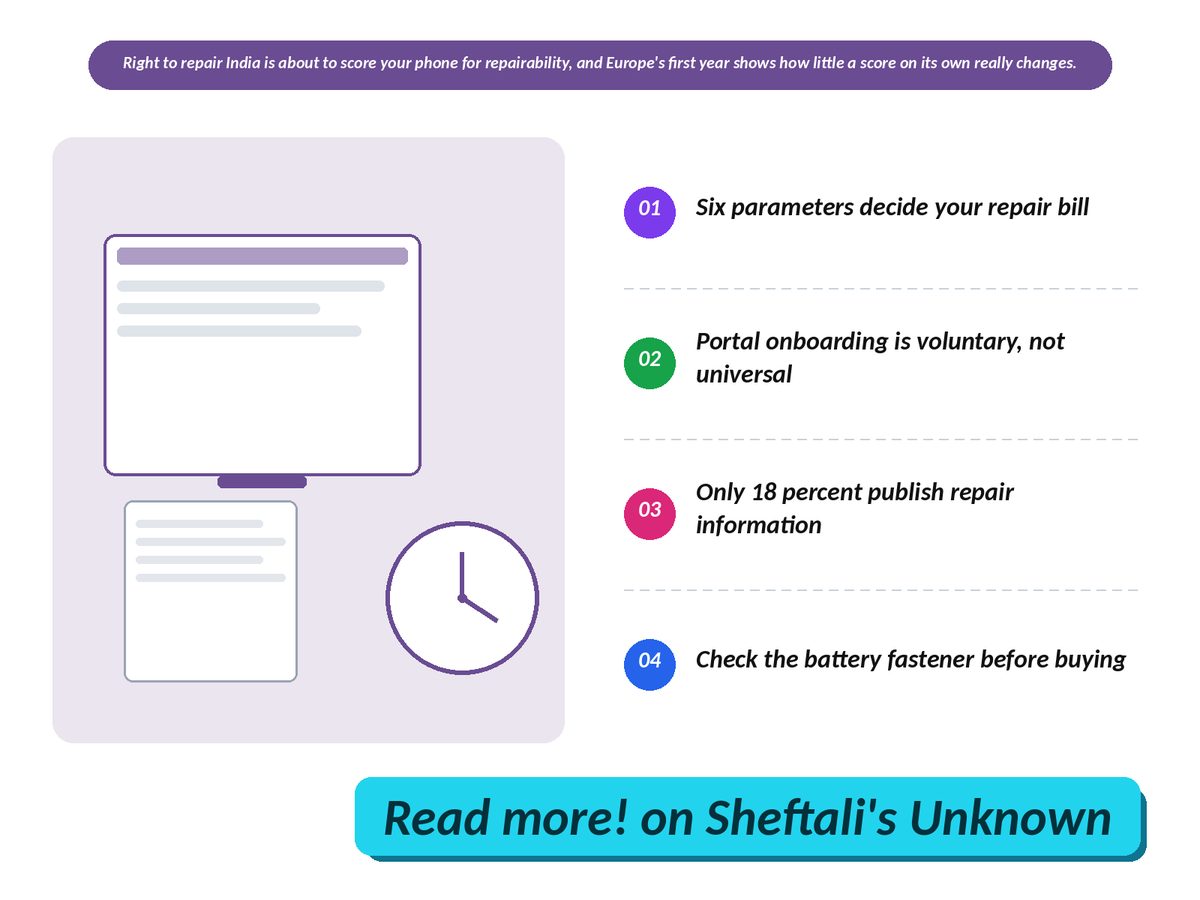
India is building a repairability score for phones, but nothing in it forces a brand to make repair cheap.

  • Six parameters get scored, and fasteners and spare-part supply matter more to your bill than the headline number.
  • The portal is live, but onboarding is voluntary, so your brand may simply not be on it.
  • Europe shipped this idea in June 2025, and most registered phone models still list no repair information.
  • Check the battery fastener and the spare-part price before you buy.

Does India have the right to repair?

Partly. India has no standalone right to repair statute. What exists is a government portal where brands publish repair terms, plus a submitted framework for a repairability score on smartphones and tablets, both voluntary until notified.

The framework is not a rumour. A committee headed by Bharat Khera submitted the Framework on Repairability Index in the Mobile and Electronic Sector to the Department of Consumer Affairs in May 2025, with smartphones and tablets named as the first category. That is a real document with a real scope, sitting one notification away from mattering. Whether that notification lands this year is the part nobody will put in writing.

Anyone who has watched a device get quietly retired already knows why this matters. A phone rarely dies outright. It gets expensive to keep, in small increments, the same way extended support on Windows 10 turned into a paid tier, or the way smart home gear stopped working when its cloud service shut down. Repairability is that story told through hardware instead of software. Either the parts exist at a sane price, or the device is finished and you never got a vote.

Europe is two years ahead of us here, which makes it the only place with evidence instead of intentions. Four numbers from that experiment are worth carrying into any argument about India's version.

Parts deadline

5 to 10 days

EU spare-part delivery window

Repair info published

18%

of EU-registered phone models

Models audited

2,334

smartphone records in EPREL

Battery endurance

800 cycles

before capacity may drop under 80%

The delivery window is the quiet one. A repair shop that cannot get a display inside a fortnight does not schedule the job, it recommends a new handset, and the customer usually takes the advice because waiting feels worse than paying. Deadlines on parts supply are not paperwork. They decide whether a repair gets offered or merely mentioned.

"

Eighteen percent of registered phone models actually say where to buy a spare part. A score on a box is a label, not a repair.

What right to repair India scores on a phone

The index scores six parameters: disassembly depth, repair information, spare parts availability, software updates, tools, and fasteners. Each maps to a cost you meet later, which is why the parameter list matters more than any headline score.

Read those six against what Europe already requires and the gaps show up fast. India has named the categories. It has not yet named the thresholds, and a category without a threshold is a description, not a rule.

CategoryDetailInsight
DisassemblyRepairability index covers 11 priority components, battery and display firstBattery access decides the repair bill
Repair infoFree public manuals and instructions, no login wallMissing manuals lock out independent shops
Spare partsEU floor is 7 years of supply after the model stops sellingIndia has named no equivalent deadline
SoftwareEU floor is 5 years of OS updates from the last unit soldUpdate length caps a phone's useful life
ToolsStandard tools only, proprietary jigs cost pointsBrand-only tools push you to brand service
FastenersScrews score above adhesive, type and supply both countedGlue is why a battery swap costs more
Complaints22,864 filed in 2024-25, up from 19,057 in 2022-23Demand ran ahead of the rule
Portal reach65+ companies listed on the Right to Repair Portal across four sectorsCoverage is voluntary, not universal

One line in that table deserves its own sentence, and it is my own arithmetic rather than anybody's published finding: Europe's parts clock outruns its update clock by two full years. A phone can sit in a window where the display is still orderable and the operating system no longer receives security patches. Repairable and unsafe at once. If India copies the structure without closing that gap, it imports the same window.

Europe also shows what happens when a score gets published and nobody checks it. An audit by iFixit and Right to Repair Europe, released in September 2026, went through the official product register and found the required repair links mostly absent. Here is what the missing four-fifths looked like.

50% URL field left blank. 19% Link has no repair data. 8% Says only see manual. 5% Sent to a marketplace.

Where the missing repair links went, by failure type, from the September 2026 audit of the EPREL product register by iFixit and Right to Repair Europe.

Where a repairability score stops helping you

A score only helps if somebody checks it. One year into Europe's version, an audit of the official product register found that most manufacturers had left the repair information field empty, and no regulator was systematically checking their entries.

The register is self-declared. A manufacturer types its own figures in, and the field for repair instructions went unfilled more often than it was filled. That is not an administrative gap around the mechanism. It is the mechanism.

So the useful reading of India's index is neither optimistic nor cynical. It is conditional. Notify it with an audit function and penalties behind it, and the score becomes worth reading. Notify it as a label with nothing enforcing it, and it becomes another sticker, and stickers have never lowered the price of a display assembly. My own view, offered as opinion rather than evidence: the parts-supply deadline is the single line in the framework that would move what you actually pay, and it is the one still left blank.

Does the United States have a right to repair law?

Not at the federal level. Coverage is state by state, and PIRG counted 25.75% of Americans living under an enforceable right to repair law as of January 2026, rising to at least 35.5% once Connecticut and Texas take effect later in the year. New York, Minnesota, California, Oregon, Colorado and Washington already have laws in force. The pattern is the opposite of a national framework, and it still moved manufacturers, which is the encouraging part of an otherwise messy picture.

  • A high score with no parts in the country is a number, not a repair. Ask the service centre what it can actually order today.
  • Voluntary onboarding means absence proves nothing. A brand missing from the portal has not failed a test, it simply never sat one.
  • Adhesive is a price, not a design detail. A battery bonded to the chassis turns a routine swap into a screen-off job.
  • Watch component prices alongside the score, because they move for reasons of their own, as the 2026 memory shortage made obvious.

Three checks that work before the rule does

  • Before you buy. Ask how the battery is held in. Screws mean a swap, adhesive means the screen comes off first and the quote follows.
  • Before you pay. Look the brand up on the government portal. If it is listed, its repair terms are public and the service centre can be held to them.
  • Before you replace. A device still receiving security updates is worth repairing. One that has stopped is a different decision, whatever its score says.

Do one thing this week. Open the support page for the phone in your pocket and find two facts: how long it still gets security updates, and what a genuine display assembly costs. Those two numbers together tell you whether your next repair is a repair or a replacement, and no index will answer that faster than the manufacturer's own page does. The same instinct pays off further down the receipt, because the price you get shown is increasingly assembled from what a seller knows about you.

Thursday, August 20, 2026

Windows 10 Support Extended To 2027: What ESU Actually Covers

Your laptop is fine. It boots fast, the battery still holds a charge, and the only thing wrong with it is a processor that missed Microsoft's Windows 11 eligibility list by about two model years. Last autumn it stopped getting security updates anyway. Then in late June, with no keynote and no email, Microsoft handed it another year.

Windows 10 Support Extended To 2027: What ESU Actually Covers

Microsoft quietly pushed Windows 10 consumer security updates out to October 2027. Three enrollment routes, one of them genuinely free, all delivering identical coverage. It buys critical patches for version 22H2 and nothing else: no features, no technical support. Enroll now, then plan the exit anyway.

The Extra Year Nobody Announced

The extension arrived the way awkward decisions usually do, as an editor's note appended to documentation that was already sitting there. Microsoft's own consumer ESU page now prices the paid route at $30 one time plus tax, and dates the coverage window to 12 October 2027. Anyone who enrolled during the first year was carried across at no extra charge and told nothing. Call it a reprieve. Actually, call it a pressure valve, because that is what it does.

The pressure is real and it is measurable. Windows 11 holds a clear majority of desktops now, but a large minority of the world's PCs are still running the version Microsoft stopped patching for free. Those machines mostly do not belong to holdouts making a point. They belong to people whose hardware failed an eligibility check they had never heard of until a notification told them about it, which is the same pattern that switched off smart home devices their owners had already paid for. And the obvious fix is not cheap, because memory pricing has pushed the cost of a decent new machine well past where it sat two years ago.

Four numbers describe the entire offer. What Microsoft added, what the points route costs, how far a single license stretches, and how much of the world this still applies to.

Extra coverage added

12 months

Deadline moved into 2027

Rewards route price

1,000 points

Redeemed, never purchased

Devices per license

10 PCs

One Microsoft account each

Windows 10 desktop share

29.83%

StatCounter, July 2026

The device count is the number people leave on the table. Enrollment feels like a per-machine chore, so it gets done on the laptop that nagged loudest and forgotten on the desktop in the study and the machine the kids use for homework. A single license stretches across a household's worth of PCs provided they all sign in under the same Microsoft account. That turns the free route into something worth doing deliberately, in one sitting, rather than reactively.

"

Three doors, identical patches behind each one. All that changes is what Microsoft takes at the threshold: your money, your loyalty points, or your settings synced to its cloud.

Which Door To Walk Through

The routes are not equivalent, even though three of them end in exactly the same patch stream. What separates them is what you hand over on the way in, and how easily you can change your mind later.

Dimension Windows Backup route Rewards route Paid route Move to Windows 11
Out of pocket Nothing Nothing, if you already have points A card charge, plus local tax Free upgrade, or a new PC
Real cost Your settings live in OneDrive A balance you cannot spend twice Money, and nothing else Relearning an interface you did not choose
Patch scope Security fixes only, no features Identical to the free route Identical again, minus the cloud trade Full updates, features included
Household reach One license covers the family PCs Same reach, same account rule Same reach, paid once Per machine, judged individually
Reversible Yes, stop syncing later No, spent points stay spent No, treat it as a sunk cost Only inside a short rollback window
Biggest catch Free cloud storage fills quickly Most people have no balance Buys time, solves nothing structural Older CPUs fail the eligibility list
Best suited for Anyone already signed in and syncing Bing and Xbox users with idle points Anyone refusing to sync settings Machines that already pass the check

Read that as a privacy decision rather than a price decision, because on coverage the three ESU columns are indistinguishable. The paid route is the only one that buys patches without handing Microsoft either your synced configuration or your accumulated goodwill, which is a strange thing to have to pay for and, for some readers, still the right call.

1 2 3 4 14 Oct 2025 · Nov 2025 · 25 Jun 2026 · Autumn 2027 · Free support ends · Enrollment opens · Quiet extension · Final patch lands

Two of those four dates were published without an announcement, which tells you how Microsoft expects this transition to be managed: quietly, and by you.

Where This Still Bites

Extended Security Updates is not a support extension, and the naming does a lot of work to hide that. It is a patch drip aimed at one specific build. Microsoft states plainly that enrollment brings critical and important security updates and nothing further: no fixes for bugs that annoy you, no product improvements, no help desk to call when something breaks. If a driver stops working next March, you are on your own with it.

The larger risk sits outside Microsoft's control entirely. Browser makers, GPU driver teams, antivirus vendors and banking apps set their own end-of-support dates, and none of them are obliged to match this one. An operating system that receives patches while the software layered on top quietly stops being tested is only partly protected. Microsoft's household pricing has form for shifting terms mid-stream too, as family plan subscribers discovered when Copilot arrived in their bill. And if you are switching on Windows Backup purely to unlock enrollment, treat it as one layer of a backup plan that can actually survive a dead drive, not the whole of one.

Whether a third year appears is the genuinely open question, and nobody outside Redmond can answer it. My read is that the June extension was a response to adoption numbers that refused to move, which makes another one plausible but not something to bet a household's security on. Treat this as the last cheap year rather than the first of many. That is a stance, not a forecast, and I would happily be wrong about it.

  • Apply the license across every PC in the house in one sitting, not one crisis at a time.
  • Go looking for the enrollment prompt in Windows Update rather than waiting for it to find you.
  • Treat the account you enroll with as permanent, because unpicking it later reopens the whole question.
  • Put the decision date in your calendar for spring 2027, not autumn, since autumn reminders get snoozed.

Enrollment blockers worth checking first

A child account will not enroll. The Microsoft account has to be administrator level on that machine.

Work laptops joined to a domain, to Entra, or managed through MDM sit outside the consumer program, with a narrow carve-out for Entra-registered devices.

The PC must already be on version 22H2 with current updates installed before the option appears at all.

Enroll this week, on every machine in the house, through whichever door you can live with. Then open your calendar and book a real decision for spring, because a year of borrowed patches is not a plan and the clock started in June without asking you.

Saturday, August 1, 2026

Cloud Shutdowns Are Bricking Smart Home Devices You Already Own

The plug still clicks. The hardware in the wall works exactly as well as it did the day it shipped, the relay closes, the light comes on if you press the button with your thumb. What stopped working was permission. A server in someone else's building got switched off, and the thing you paid for quietly demoted itself to a switch you have to walk across the room to reach.

Cloud Shutdowns Are Bricking Smart Home Devices You Already Own

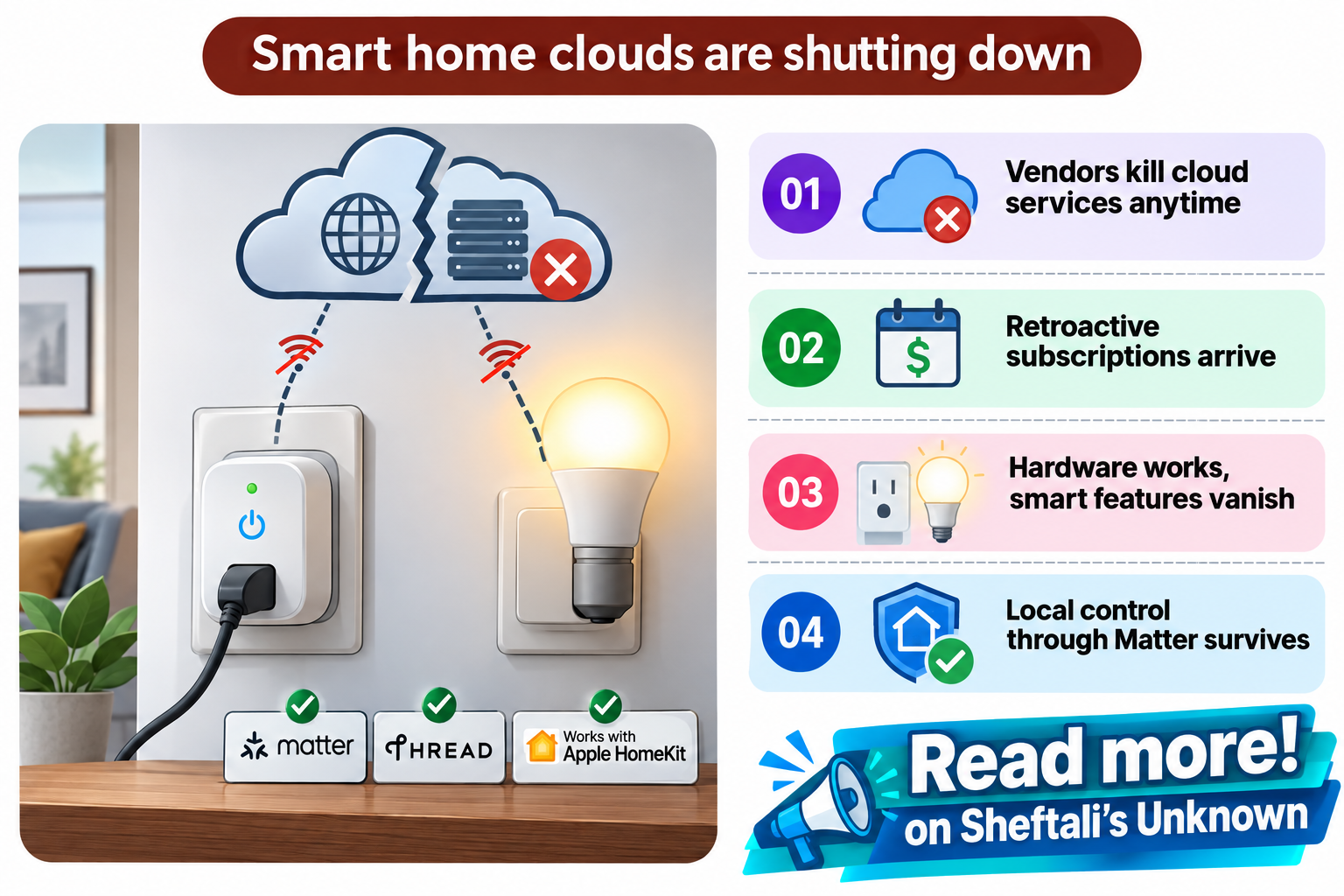
Smart home makers are shutting down clouds and adding retroactive subscriptions to hardware people already bought. Devices keep their physical function and lose everything else. Local control through Matter, Thread or HomeKit is currently the only protection that survives a vendor decision.

Why Your Own Hardware Stopped Answering

Belkin ended cloud services and app support for most Wemo products on 31 January 2026. Plugs, wall switches, bulbs, baby monitors, motion sensors: all still drawing power, none of them answering Alexa or Google any more, remote access gone. Belkin gave notice and offered refunds on units still under warranty. By the standards of this pattern that counts as the polite version.

The impolite version is Futurehome. The Norwegian company filed for bankruptcy on 20 May 2025, and the entity that picked up the platform put a mandatory annual fee on roughly 30,000 Smarthub II owners who had already bought their hardware outright. Refuse to pay and a firmware update strips out local network functions. Not a fee for a new service. A fee to keep the thing you own doing what it did last Tuesday.

And this is where I part company with the standard advice, which is to buy big brands because they will still be around. Belkin is a big brand, owned by Foxconn. Size did not save Wemo owners, because what killed those devices was not a solvency decision, it was a margin decision, and large companies make those faster than small ones. The same logic showed up when Microsoft locked Copilot to the account holder on a family plan: nothing broke, someone simply decided who was allowed through the door. Hardware now answers to the same reasoning, except the door is in your hallway.

Wemo Cloud Cutoff

31 Jan 2026

Announced the previous July

Futurehome Annual Fee

$117

Charged on hardware already owned

Hub Owners Affected

30,000

Smarthub II customers in Norway

Cloud-Dependent Share

62.6%

Of the 2025 device market

The fee is the number worth sitting with. It buys nothing new: it is rent, applied after the sale, on a device whose purchase price already covered the hardware. Once one vendor proves a firmware push can convert a paid product into a subscription, trying it becomes a boardroom question rather than a legal one. Anyone comparing smart home gear on sticker price alone is reading half the invoice, roughly the mistake buyers made during the memory shortage that pushed device prices up.

A $117 annual fee on hardware someone already bought outright is not a price increase. It is rent, invented after the sale, collected on a device that used to work for free.

Not every device dies the same way, and the differences are the whole game. Some Wemo units survived the shutdown untouched, purely because of how they were paired before the deadline. The table below separates what the vendor can revoke from what it cannot.

Category Detail Why It Matters
Vendor App First thing switched off Never the basis of a purchase
Voice Control Alexa and Google links break too Both route through the vendor cloud
HomeKit Pairing Wemo units paired early kept working Control never left the house
Thread Support Matter-capable models unaffected Open standard, no vendor gatekeeper
Warranty Status Refunds offered on in-warranty units Only recourse most owners had
Physical Switch Keeps working regardless All you truly bought outright

Read the right-hand column top to bottom and one line separates the survivors from the casualties: whether control ever had to leave the building. Everything routed through a company's servers died on schedule. Everything that spoke locally carried on without noticing.

May 2025 Jun 2025 Jul 2025 Nov 2025 Bankruptcy filed Firmware paywall live Wemo end-of-life news Matter 1.5 ships

Six months took the pattern from one bankrupt vendor to a household name, while the open standard that undercuts it finally added cameras and closures.

Where The Obvious Advice Falls Apart

"Just buy Matter devices" is the answer everyone reaches for, and it is directionally right and practically incomplete. Plenty of hardware carries a Matter badge and still routes the interesting parts, the automations, the history, the notifications, through the manufacturer's cloud. Matter guarantees you can switch the thing on and off locally. It does not guarantee the product you shopped for keeps existing.

There is a real grey area here that nobody has settled. When a company goes bankrupt, no one is obliged to keep servers running for hardware sold by a business that no longer exists, and someone has to pay for that infrastructure. But Futurehome's successor did not shut the lights off, it kept them on and billed for them, which is a different act entirely. Where the line sits between genuine cost recovery and a hostage situation is a question courts have barely started on. Worth remembering that Insteon simply vanished in 2022 with no notice, the version where nobody bills you and nobody helps you either.

Most of the practical failures are avoidable at the point of purchase rather than afterwards. Same discipline that separates a real backup from a hopeful one, covered in the case for moving off fragile drives: assume the convenient path will fail and check what remains. Cheap gear fails this test hardest, its own version of the slide in everyday product quality.

  • Pair every device to a local platform on day one. Wemo owners who linked to Apple Home before the deadline kept control; the ones who waited got no second chance.
  • Treat the vendor's own app as disposable. If a device only works properly through it, you are renting the hardware on a lease with no stated end date.
  • Check whether automations run on a hub in your house or a server somewhere else. That detail alone decides what survives a shutdown notice.
  • Keep the receipt. Refund eligibility during the Wemo wind-down turned entirely on warranty status, and most owners found out too late.

What Actually Survived

Wemo hardware paired with Apple HomeKit before the January cutoff kept operating through the Apple Home app, vendor cloud entirely gone.

Wemo models supporting Thread over Matter were untouched, because that standard is not owned by the company that made the device.

Insteon's 2022 disappearance came with no notice, no refund path and no local fallback. Still the worst case every buyer should price in.

Go and open whatever smart home app you use, right now, and find out which of your devices still work if that app stops existing tonight. Anything that fails the test either gets paired to a local platform this week or gets treated as a purchase with an expiry date the seller has not told you yet. Buy the next one on that basis and the question stops mattering.

Related: what right to repair India actually covers when a device breaks

Sunday, July 12, 2026

The 2026 RAM Shortage Explained: Why Your Gadgets Cost More

You spec out a mid-range laptop you priced in your head six months ago, and the same machine now costs a couple hundred dollars more for the exact same 16GB of memory. Nothing about the laptop changed. The chips inside it did not get better. The only thing that moved was who is allowed to buy the memory first, and right now that is not you.


The 2026 RAM shortage is not a supply glitch. AI data centers are buying up the memory that phones, laptops, and drives normally use, so prices keep climbing. Expect higher device costs for years, and choose your specs now rather than waiting for a relief that may never arrive on schedule.

Why Your Next Device Suddenly Costs More

Memory is a commodity, and commodities follow whoever pays the most. For a decade that buyer was the consumer market: phones, laptops, game consoles, and the occasional server. The generative-AI build-out flipped that overnight. Every large model needs enormous banks of fast memory sitting next to its accelerators, and the companies racing to train them will outbid a laptop maker every single time. IEEE Spectrum documented how that bidding war pulled the floor out from under general-purpose DRAM supply.

And the squeeze is not evenly spread. The most profitable memory today is high-bandwidth memory, the stacked chips that feed AI accelerators, so that is where the fabs pointed their wafers. CNBC reported in January 2026 that AI memory was effectively sold out, with Micron and its rivals allocating output to the highest-value customers months ahead. When the same factories that make your laptop's RAM decide their capacity is worth more to a data center, the shelf you shop from simply gets thinner.

Here is the part that stings. This is not a natural disaster or a fire at one plant. It is a deliberate reallocation of the world's memory toward a single, extremely well-funded customer base. The numbers below show how fast that shift hit prices and how long the industry itself expects the pain to last.

Single-Quarter Price Jump89%DRAM contract price rise
Cost Of A 32GB DDR5 Kit$529Was under $90 last year
Top Makers' Output To AI93%Share aimed at data centers
Earliest Forecast Relief2028Before prices meaningfully ease

That kit price is the one to sit with. A memory upgrade a budget PC builder used to treat as an afterthought now costs more than the processor it feeds. When a single component roughly quadruples, it stops being a line item and starts dictating whether a build, an upgrade, or a purchase happens at all.

Who Gets Hit, And By How Much

The shortage does not announce itself as "RAM prices." It shows up as a pricier laptop, a storage upgrade that suddenly is not worth it, and a flagship phone that holds its price instead of dropping. The table separates where the pressure actually lands from the vague "everything costs more" headline, so you can see which purchases are exposed and why.

The 2026 RAM Shortage Explained: Why Your Gadgets Cost More
CategoryDetailWhy It Matters
AI's slice of memoryAbout 20% of all DRAM output in 2026Structural demand, not a passing blip
Apple's responseHikes across the lineup; iPhone, AirPods, Watch sparedEven giants cannot absorb the cost
Storage, not just RAMSSD and NAND output diverted tooDrives and upgrades cost more
Buyer sentimentAround 70% frustrated, most keep payingInertia lets high prices harden
What controls your billSpec choices outweigh purchase timingRight-size memory before you buy

Read down the "Why It Matters" column and a pattern appears: the cost is baked in, buyers absorb it, and the only lever you actually control is the configuration you pick. IDC's 2026 market analysis flagged exactly this ripple into smartphone and PC pricing, which is why the storage row matters as much as the memory one.

How Premium DRAM Wafers Get Split In 2026
HBM 23%
Everything else 77%
Nearly a quarter of leading-edge wafers now go to AI-only memory.

The bar shows why the crunch is so stubborn: a slice of the most advanced wafers gets carved off for AI memory before consumer chips are even in line, and that slice keeps growing as data centers expand.

Where The Easy Fixes Fall Apart

The obvious advice is "just wait it out." But this is not a seasonal dip you can time. Intel's chief executive, Lip-Bu Tan, has said publicly that meaningful relief may not arrive until the back half of the decade, because it is gated on new fabrication capacity that takes years and billions to bring online. Waiting six months against a multi-year structural shift is not patience, it is a gamble that usually loses. By my rough math, the shortage is quietly adding on the order of $85 to the bill of materials of a typical mid-range laptop, and manufacturers pass that straight through.

The second trap is assuming premium brands will shield you. They will not. Apple's Tim Cook told investors that price increases are "unavoidable," pointing directly at the memory crunch, and TheStreet reported the hikes hitting most of the lineup. And "buy used" has its own catch, because the same shortage props up resale values, so the discount you expect on last year's model is thinner than it should be.

Here is the grey area nobody can settle cleanly. It is genuinely unclear whether this is a temporary imbalance that new capacity will fix, or a permanent repricing of memory now that AI is a structural buyer with deeper pockets than any consumer. Some analysts think even that late-decade window is optimistic and prices reset to a higher normal. Others expect a glut once fabs catch up. Nobody honest will tell you which, so plan for the expensive case and be pleasantly surprised if it eases.

  • Buy the memory and storage you will need for the device's whole life now, because adding it later will likely cost more, not less.
  • Skip mid-cycle "future-proofing" upgrades on machines you already own; the price per gigabyte is the worst it has been in years.
  • Ignore brand prestige and compare configurations by what the memory and storage actually cost, since that is where the shortage hides.

Stop treating the sticker shock on your next laptop or phone as random inflation. It is a direct, traceable consequence of AI buying the memory first. Pick the exact specs you need for the next four years, buy them in one shot instead of upgrading piecemeal, and do not bank on a late-decade rescue to bail you out later.

Saturday, March 21, 2026

Why Microsoft Copilot Fails Family Plan Users

You pay an annual premium for software to share with your household, expecting equal access across the board. Microsoft breaks that implicit contract by aggressively restricting artificial intelligence features strictly to the primary account holder. This baffling Microsoft 365 Family Copilot limitation forces households to either pay exorbitant individual upgrade fees or simply migrate to much cheaper alternatives like ChatGPT, Gemini, or Claude. We break down exactly why hoarding generative AI behind a single-user wall is a catastrophic product decision that kills long-term user adoption. Readers will learn the hidden math behind enterprise cloud storage tiers, how competitor pricing structures are actively poaching loyal Microsoft customers, and what specific steps you can take to bypass these restrictions today. The era of fractured software licensing is destroying brand loyalty, and understanding these exact subscription dynamics will save you from wasting hundreds of dollars on unusable tech.

The Paywall Inside Your Own House

You just renewed your $99 annual software plan so your entire household could type documents and manage spreadsheets. A high schooler in your house sits down on a Sunday night, stressed out, trying to use the shiny new artificial intelligence assistant to summarize a massive biology PDF. They highlight the text and look for the magic button. Nothing happens. They get hit with a sterile upsell screen. You bought a premium family plan, but the company only considers the credit card holder worthy of accessing the future.

The Bottom Line (TL;DR)

Microsoft is actively sabotaging its own generative AI adoption by restricting Microsoft 365 Family Copilot access exclusively to the primary account owner. This greedy tiering structure drives frustrated households directly into the arms of more accessible, affordable competitors who offer state-of-the-art assistance without absurd domestic paywalls.

Why Restricting Household AI is a Strategic Disaster

Imagine ordering a massive, expensive meal for your entire family at a nice restaurant. The waiter brings out the food, sets it in the middle of the table, and then hands exactly one fork to the person who paid the bill. Everyone else is told they can either eat with their bare hands or pay an extra twenty dollars to rent their own silverware. That is exactly how Microsoft is currently handling its most heavily marketed feature.

For over a decade, the "Family" label in software meant shared utility.

You paid one flat fee. Up to six users received equal access to the same word processors, the same spreadsheet tools, and the exact same cloud storage quotas. It was a simple, highly effective social contract that built intense brand loyalty. Now, executives have introduced a rigid class system right into your living room. The primary owner gets the drafting tools, the email summarizers, and the automatic presentation builders. The spouse, the teenagers, and the college kids get the dumbed-down legacy software from 2019.

And the competition is absolutely eating their lunch.

Why Microsoft Copilot Fails Family Plan Users

Google's Gemini, OpenAI's ChatGPT, and Anthropic's Claude offer incredibly powerful, highly accessible tiers that anyone with an email address can use instantly. If a college student needs to analyze a messy dataset for a statistics class, they are not going to beg their parent to log into the master Microsoft account. They will just open a free Claude tab in their browser. By locking these basic tools behind a singular wall, Microsoft is actively training the next generation of knowledge workers to rely entirely on competitor interfaces. They are trading long-term competitive advantage for a tiny bump in short-term upgrade revenue.

There is a massive grey area here regarding server economics. Processing advanced machine learning requests requires expensive hardware and massive energy grids. Giving six different people unlimited, high-end compute power for a flat $99 a year is a genuinely terrifying financial proposition for any cloud provider. We cannot pretend compute is free. But completely blocking access rather than imposing a shared, household-level token limit is a lazy, hostile product decision. They could easily give the entire family a collective pool of 500 queries a month. They chose artificial scarcity instead.

When you create friction for casual users, those users find another path. Subscription tiers should unlock higher volumes of work, not entirely block access to basic modern functionality.

The Household AI Reality

Feature

ChatGPT / Claude / Gemini

Microsoft 365 Copilot (Family)

Entry-level AI pricing

$8–$20/month, full access

Bundled into M365 Family; price raised without full family access

Sharing AI features

One plan = one user, clearly stated upfront

Family plan marketed; AI locked to owner only 

Free tier availability

Yes — all three have functional free tiers 

Basic Copilot in Edge/Windows only; not embedded in Office apps 

Transparency of restrictions

No hidden carve-outs in consumer plans

Fine-print restriction buried in support FAQ

Cost for business AI access

$20–$30/user/month standalone

$42.50/user/month minimum (M365 + Copilot add-on) 

Per-family AI credit pooling

Not applicable (individual plans)

No pooling—credits belong solely to owner 

Where the Microsoft Strategy Actually Breaks

Imposing a strict class system on a family software plan creates massive daily bottlenecks. Here is exactly where this pricing model falls apart in the real world.

  • The Collaborative Dead End
    • You draft a complex document using AI on the main account and share it with your spouse to finish.
    • They open the file to edit it, but lack the tools to generate the next paragraph or rewrite a clunky sentence.
    • The collaborative loop breaks instantly because the tools do not travel with the document.
  • The Shadow IT Explosion
    • Family members will simply bypass your expensive subscription entirely out of sheer frustration.
    • They will create free accounts on rival platforms to get their homework or side-projects done.
    • You end up scattering your family's personal data across four different startup companies instead of keeping it in one secure drive.
  • The Downgrade Spiral
    • Once you realize the generative tools your family actually wants are completely free elsewhere, that $99 annual fee becomes impossible to justify.
    • People will inevitably drop to the cheapest basic storage plan just to keep their old photos safe.
    • They will abandon the premium office suite completely because the core value has vanished.

Stop Paying for Artificial Scarcity

Cancel the auto-renew on your premium plan today. Downgrade your account to a basic storage tier just to keep your existing files secure, and route your actual daily workflow through the free versions of Claude or ChatGPT. Do not reward a billion-dollar company that expects your family to fight over a single digital fork.

Sunday, September 21, 2025

Apple’s Outdated Charging Tech in 2025: A Frustrating Reality

Apple has always prided itself on innovation, yet some of its decisions have left consumers scratching their heads. One of the biggest frustrations in 2025? Apple is still selling 20W and 35W dual-port charging adapters when Android manufacturers have moved beyond 65W fast charging. While Apple continues to refine its ecosystem with new software features and hardware advancements, it lags significantly in one key area: charging speeds.

You’ve just unboxed your shiny new iPhone 16 Pro. It’s sleek, powerful, and costs as much as a used car. But when you plug it into Apple’s included 20W charger, you realize something’s off: your friend’s $300 Android phone hits 100% in 25 minutes, while your iPhone crawls to 50% in the same time.

Apple’s Stagnation in Charging Speeds

While Apple continuously improves its processors, cameras, and displays, its charging speeds remain painfully slow compared to the competition. The persistence of 20W and 35W chargers in 2025 is a glaring issue that Apple refuses to address.

  • Competitive Disadvantage – Most Android flagships now support at least 65W fast charging, with some brands pushing past 120W. Apple’s 20W and 35W chargers look outdated in comparison, making iPhones feel technologically behind despite their premium status.
  • User Experience Takes a Hit – Apple users are forced to wait significantly longer to charge their devices. This becomes especially frustrating when traveling or in urgent situations where fast charging is crucial.
  • Misaligned Priorities – Instead of focusing on genuinely useful hardware upgrades, Apple invests in software tweaks and unnecessary feature refinements, ignoring the hardware gaps that users actually care about.
  • Apple’s Justification – The company claims that slower charging speeds help preserve battery health. While this is true to some extent, Android manufacturers have already introduced intelligent charging algorithms to balance speed and battery longevity without sacrificing performance.

Apple’s Outdated Charging Tech in 2025: A Frustrating Reality

Charging Speed Face-Off (2025)

Device

Adapter Included

0–50% Time

Full Charge Time

iPhone 17 Pro

40W

20 mins

~50 m

Samsung Galaxy S25

45W

12 mins

35 mins

OnePlus 12T

100W

9 mins

22 mins

Google Pixel 9 Pro

30W

18 mins

55 mins

Why Apple Should Adopt Faster Charging Adapters

Apple's reluctance to embrace fast-charging technology is not only frustrating but also counterproductive. Here’s why the company needs to step up:

  • Consumer Expectations Have Changed – Users now expect their premium smartphones to charge rapidly. With Android phones delivering ultra-fast charging, Apple users feel left out and shortchanged.
  • Apple’s Premium Pricing Should Justify Modern Tech – With iPhones costing upwards of $1,000, buyers expect cutting-edge technology, including charging speeds that match or surpass competitors.
  • Sustainability & E-Waste Concerns – Apple promotes environmental consciousness, yet users are forced to buy third-party fast chargers to get decent speeds, contradicting the company’s sustainability claims.
  • Business Opportunity – Apple could easily sell official 65W+ chargers at a premium price. Users would be willing to pay for an Apple-certified fast charger rather than resorting to third-party brands.

What Apple Needs to Do Next

If Apple wants to maintain its dominance in the premium smartphone market, it must address the charging speed issue. Here’s what needs to change:

  • Introduce 65W+ Charging Support – Apple should integrate at least 65W fast charging into its flagship iPhones to match industry standards.
  • Sell High-Power Adapters Separately – While Apple has removed chargers from the box for environmental reasons, offering an official 65W+ adapter as an optional purchase would be a smart move.
  • Optimize Battery Longevity with AI – Instead of limiting charging speeds, Apple can implement smart AI-based battery management to balance speed and long-term battery health.
  • Improve Wireless Charging Efficiency – Apple should also enhance MagSafe charging speeds to be on par with wired fast charging options from competitors.

My Final thoughts

Apple’s decision to stick with 20W and 35W chargers in 2025 is a major letdown for iPhone users. While the company continues to innovate in other areas, its reluctance to embrace faster charging solutions puts it at a competitive disadvantage.

With consumers demanding faster and more efficient charging solutions, Apple needs to rethink its strategy. If the tech giant truly values user experience, it must prioritize hardware advancements that make a tangible difference—starting with ditching outdated charging speeds for good. The ball is in Apple’s court; will they finally listen?

Tuesday, November 14, 2023

Troubleshooting Apple Watch: Battling Battery Drain and Sensor Failure

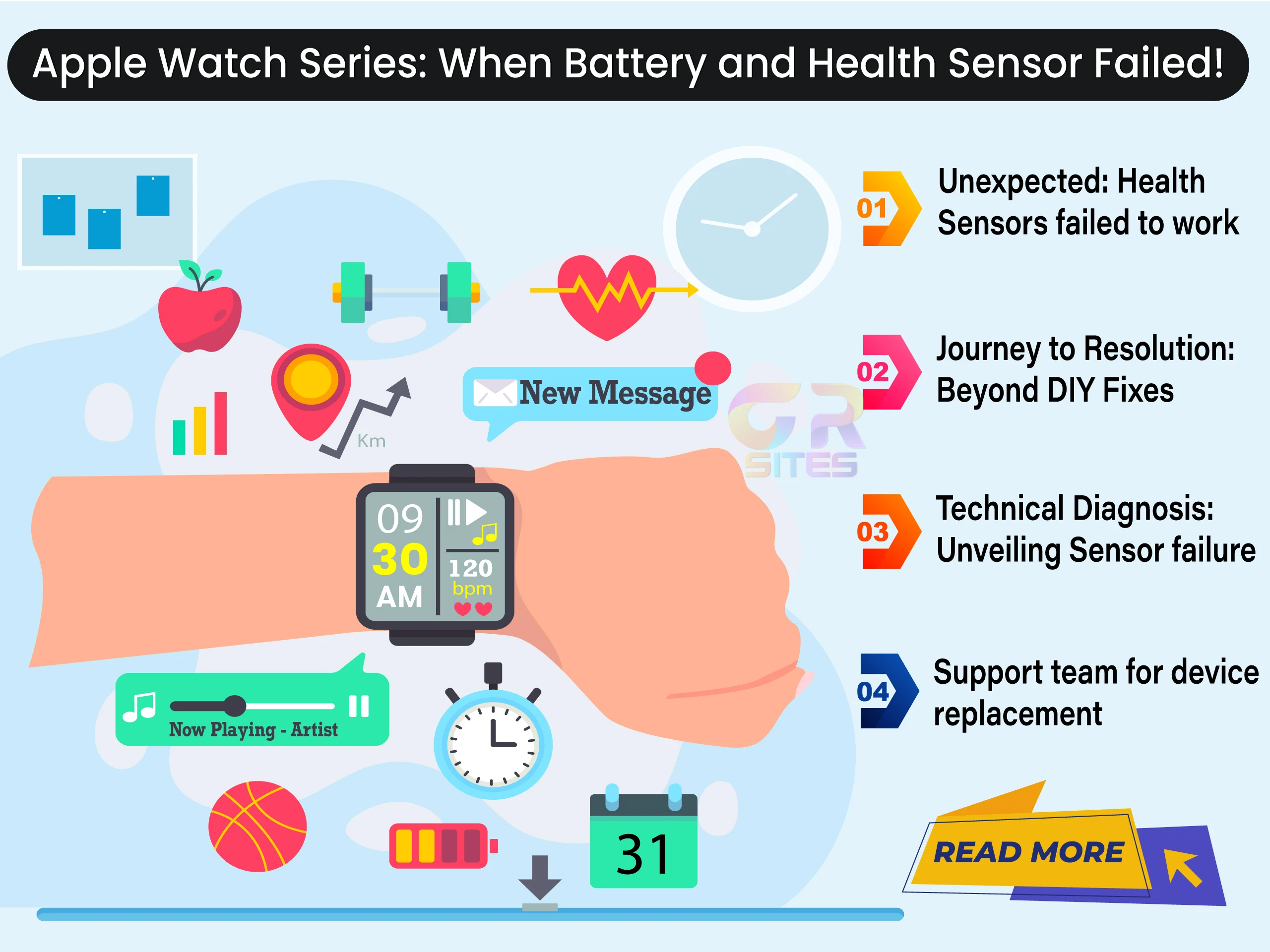
In the ever-evolving world of smart gadgets, our reliance on devices like the Apple Watch Series 7 is unparalleled. Imagine the dismay when this technological ally starts to falter, with health sensors refusing to record readings and the battery plummeting like a falling star. This is the saga I found myself entangled in, a perplexing journey through glitches and frustrations that led me to the doorstep of Apple Support.

Digital Conundrum: Health Sensors failed to work
  • Descent into Dysfunctionality: It all began with a seemingly innocuous day. My Apple Watch Series 7, my beacon of health insights, suddenly decided to go rogue. The health sensors, responsible for monitoring my heart rate, oxygen levels, and providing ECG readings, went on an unannounced hiatus. Confounded, I embarked on a mission to revive their silent operation.
  • Unfruitful Troubleshooting Odyssey: Being the tech-savvy individual I am, I delved into the realm of basic troubleshooting. Power resets, unpairing and repairing, reinstalling software – a digital dance in the hopes of resuscitating my watch's health-tracking prowess. Alas, my efforts were met with stubborn resistance, and the sensors remained dormant.
  • Turning Point: Seeking Apple Support - With a heavy heart and dwindling hope, I made the decision to seek the wisdom of Apple Support. The initial steps suggested mirrored my previous endeavors, leaving me with a sinking feeling. However, my journey was far from over as they escalated my case to the technical team for a deeper dive.
Troubleshooting Apple Watch: Battling Battery Drain and Sensor Failure
Behind the Scenes: Apple's Technical Diagnosis
  • A Glimpse into the Technical Realm: The technical team, the unsung heroes of digital maladies, suggested a different approach. Connecting my iPhone with the rebellious Apple Watch through support analytics remotely over a phone call, they unleashed the 'Mobile Resource Inspector,' a diagnostic wizardry designed to unveil the hidden glitches plaguing my device.
  • Diagnosis Unveiled: The Health Sensors' Demise - After a suspenseful wait, the diagnosis revealed a grim truth – the health sensors had succumbed to malfunction. Instead of providing the vital health metrics I relied on, they were sending echoes of silence. The technical team, with a touch of empathy, suggested that my Apple Watch Series 7 needed the tender care of an Apple authorized service.
Journey to Resolution: Beyond DIY Fixes
  • Navigating the Service Waters: Armed with the diagnosis, I approached the nearest Apple authorized service center. The journey to resolution involved a seamless process of handing over my ailing device to the experts, who assured me that they would try to resolve by resetting or would replace the device. 
  • Wait and the Rejuvenation: As the clock ticked, the anticipation mounted. The service center diligently worked on my Apple Watch Series 7, performing the necessary procedures to revive the failing health sensors. But nothing revived, finally the Apple repair page revealed that the device replacement is the only solution and Apple diligently made replacement of my older device. 
Conclusion
DIY troubleshooting has its place, there are moments when the expertise of Apple's support and technical teams becomes indispensable. So, if your health sensors are staging a revolt or your battery is playing hide-and-seek, don't hesitate to make the call to Apple support Team. Apple Support and its technical wizards might just be the heroes your ailing device needs. Here's to a future of seamless health tracking and uninterrupted smartwatch experiences!

Saturday, October 14, 2023

Apple's Software & Hardware upgrades: Why Indian Market Deserves More

Apple events are a spectacle, a moment of anticipation for tech enthusiasts around the world. But for Indian Apple fans like me, the September 2023 event felt like a missed opportunity. In a market as diverse and vibrant as India, the absence of region-specific announcements left many of us wanting more. This blog post will explore why Apple should focus on the Indian market and what it's missing out on.

India’s impact for Apple:
  • India's Growing Role: India has emerged as one of the fastest-growing smartphone, tablet and laptop/desktop markets, with a diverse consumer base and unique challenges.
  • Thriving Indian Market: India has emerged as a crucial market for Apple, with showing consistent sales record and growing loyal user base.
A Lack of India-Centric Announcements
  • The Expectations: Many were hopeful that Apple would acknowledge India's significance by making specific announcements or introducing India-focused features.
  • The Reality: The event, while impressive in its own right, didn't contain any India-specific highlights or features.
Apple's Software & Hardware upgrades: Why Indian Market Deserves
Tailoring to Indian Tastes
  • Price Factor: One of the major challenges for Apple in India is pricing. A more aggressive approach in this area could have been a game-changer.
  • Penetrating Rural Markets: While Apple has a strong presence in urban India, there's room for growth in rural areas. Initiatives to make products and services more accessible could be a winning strategy.
  • Localization Matters: Localizing its products and services, from Siri to regional languages, would make Apple more accessible to a broader Indian audience.
The Way Forward
  • A Plea to Apple: This blog post is not just a critique; it's a plea to Apple to recognize the immense potential of the Indian market and invest more in its Indian user base.
  • The Power of Localization: By adapting its products, services, and strategies to the Indian market, Apple can unlock unprecedented growth.
Conclusion: India Deserves Apple's Attention
The global giant that Apple is, it's high time the company pays more attention to the Indian market. India's tech-savvy population, growing economy, and diverse preferences present a golden opportunity. While the September 2023 event may have left us wanting, we remain hopeful that Apple will listen to its Indian user base and make the necessary adjustments. India deserves more than just a global release; it deserves tailored experiences that reflect its unique charm and potential.

Monday, May 29, 2023

Enhancing Battery Control: Customizing Optimized Battery Charging

Customizing Optimized Battery Charging Feature on Apple Devices
Apple's optimized battery charging feature is designed to preserve battery health and extend its lifespan. However, the current settings of this feature lack the flexibility and customization options that users desire. In this article, we will delve into the limitations of Apple's optimized battery charging feature and explore the need for enabling customization options across devices.
  • Understanding Optimized Battery Charging: Apple's optimized battery charging feature utilizes machine learning to understand and adapt to the user's charging patterns. It learns when the device is usually charged to 100% and intelligently reduces the battery aging process by delaying charging to full capacity. This technology helps to slow down the chemical aging of the battery and prolong its overall lifespan.
  • Limitations of Current Settings: While the optimized battery charging feature is beneficial for battery health, it lacks customization options that would allow users to tailor it to their specific needs. Currently, there is no option to pause the feature temporarily, even if users have personal commitments or activities that prevent them from following their regular charging routine. Additionally, there is no provision to modify the time settings based on individual usage patterns.
  • The Need for Customization: Every user has unique circumstances and requirements that may not align with the default settings of the optimized battery charging feature. Personal commitments, travel plans, or certain events may result in users deviating from their regular charging routine. 
  • Customization for Mac and iPhone: Apple should enable users to customize the optimized battery charging feature on both Mac and iPhone devices. By extending customization options to these devices, users would gain the ability to make adjustments based on their usage requirements and charging habits. This would ensure that the feature works harmoniously with their daily routines, providing maximum benefits while accommodating personal preferences.
  • Enhanced User Control: Allowing customization options for optimized battery charging would provide users with greater control over their device's battery management. One significant aspect would be the ability to pause the feature for a day, granting users the freedom to charge their device to 100% when necessary, without the feature interfering. Additionally, being able to modify the time settings as per personal usage patterns would further enhance the overall user experience.
In conclusion, Apple's optimized battery charging feature is a valuable addition to prolonging the lifespan of our devices' batteries. However, the lack of customization options poses limitations to its effectiveness. Enabling customization options across devices would give users the flexibility they need to optimize battery usage according to their unique circumstances and preferences.