A debit card will not let you wait, and the word that hides it is "unauthorized." Whatever the card's marketing promises, debit card fraud liability under federal law runs on a clock: report within two business days of learning about the theft and you owe at most $50, report later and the ceiling becomes $500. Credit has no clock. Its cap is $50 on any day, and you pay the difference.
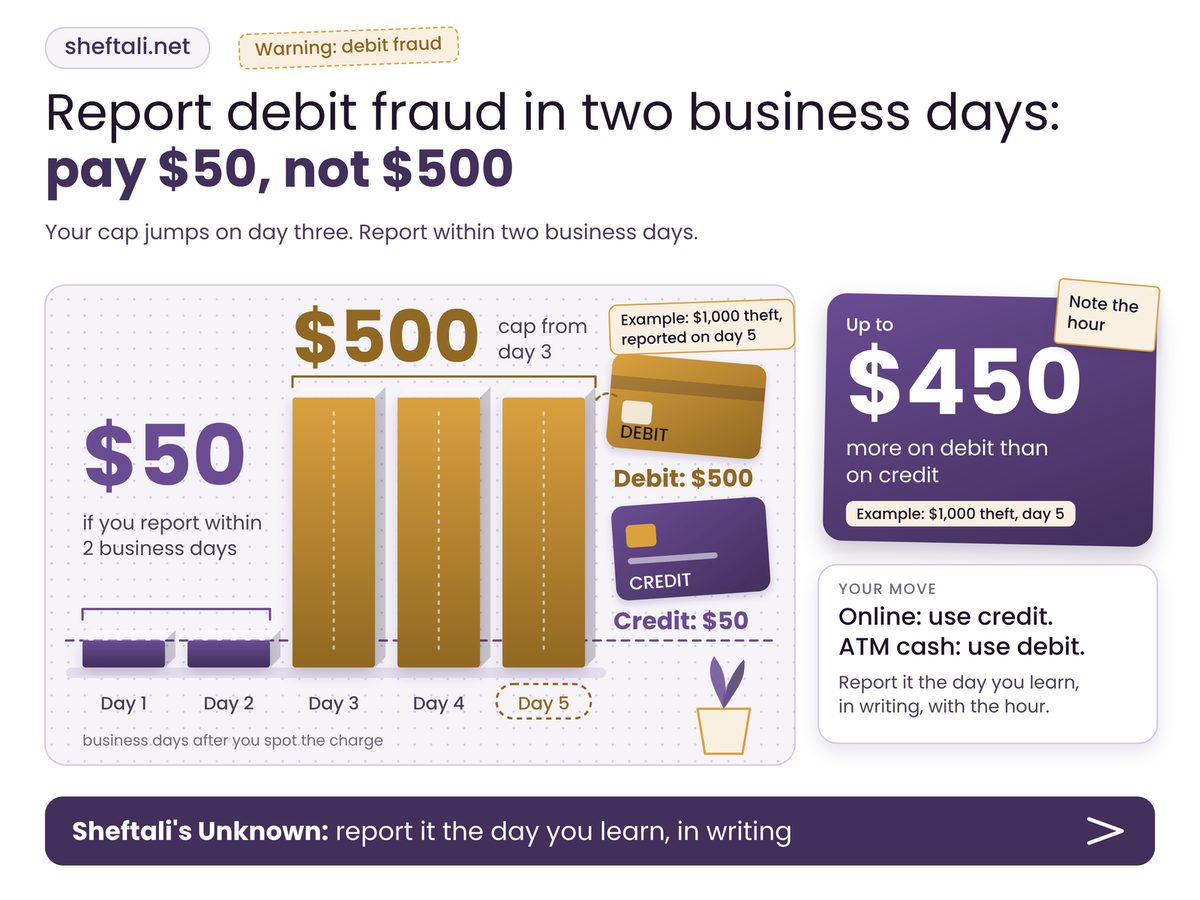
Debit liability stays capped at $50 only if you report within two business days of learning of the theft; credit stays at $50 on any day.
- Day three lifts the debit ceiling to $500 (12 CFR 1005.6(b)(2)).
- Ignore a statement for 60 days and later thefts can be yours in full.
- Our rule: if you open your account less often than every two business days, online purchases belong on credit.
How does debit card fraud liability change after two business days?
It steps up in tiers: $50 if you notify within two business days of learning of the loss, up to $500 after that, and potentially more if you ignore a statement for 60 days.
Read the rule's own words. Regulation E, 12 CFR 1005.6(b)(1) says liability "shall not exceed the lesser of $50 or the amount of unauthorized transfers" when you notify in time. Miss the window and (b)(2) lifts the cap to the lesser of $500 or up to $50 from the first two days plus every later transfer the bank can show your notice would have stopped. Ask CFPB, reviewed 28 August 2026, says you "could be responsible for up to $500."
Credit sits under Regulation Z. Section 1026.12(b)(1)(ii), current to 22 October 2026, says liability "shall not exceed the lesser of $50" of what the thief obtained before you notify the issuer. No day count, no second tier.
Four numbers frame the gap. Two come from the rule and the CFPB; two are our arithmetic on the caps.
Bank Investigation Time
10 business days
Typical wait before temporary credit
Most Debit Adds Over Credit
$450
Derived: $500 cap less $50
Liability Steps On Debit
3 tiers
Credit has one flat tier
Ceiling Jump After Day Two
10x
Derived: $500 divided by $50
Time is the part you can still control. The bank's own clock is slower: Ask CFPB says it must resolve a dispute in 45 days, or 90 for point-of-sale debit purchases.
Everything turns on one deadline. Inside it, debit and credit cost you the same, $50 at most. Past it, only credit keeps that cap.
Count the clock from tomorrow. Comment 6(b)(1)-3 of the official interpretation leaves out the day you learn of the loss and any day your bank is closed for business. Our reading: learn on a Friday at a bank shut at weekends and the window closes at the end of Tuesday. Call it two days. Strictly, it is two business days.
The word doing the work is "unauthorized." A transfer you start yourself is a different case, and two scams here end there: the fake check overpayment scam and the Bitcoin ATM scam. Whether the rule reaches them depends on facts we cannot see.
Worked example: assume a thief takes $400 in your first two business days and $600 more over the next three, you report on business day 5, and the bank can show the $600 was preventable. On debit, the first piece is the lesser of $50 or $400, so $50; add $600 to reach $650, which the $500 ceiling cuts to $500. On credit, the same $1,000 is capped at $50. That is $450 more on debit, our arithmetic, and it is the liability sum to run with your own numbers.
What should you do in each situation?
Report to your bank the day you learn of the problem, in every situation below; what changes is the deadline you are racing and what a late report costs you.
Find your row and do the action beside it today.
| If you | Do this | Because |
|---|---|---|
| ⏱ Learned today | Call now, confirm in writing | Two business days caps you at $50 |
| ⏱ Past day two | Report anyway, today | Ceiling rises to $500, not $50 |
| 🧾 Odd charge | Report within 60 days of statement | Later thefts can be yours in full |
| ⚖️ Fake bank call | Report as unauthorized | CFPB FAQ 5 covers shared logins |
| 🛠 Not sure | Report now; sort out details later | Both $50 and $500 turn on report date |
Our arithmetic: deadlines count from the day you learn or the statement date.
Does the same $1,000 theft cost you the same on a debit card and a credit card? No: reported on business day 5, you carry half of it on debit and one-twentieth on credit. Our arithmetic, on the worked example's assumptions.
Where does the $50 cap stop protecting you?
It stops where you sit on a statement past 60 days, where a transfer is one you started yourself, and where your issuer's own promise differs from the law, so check all three.
The sharpest edge is the statement. Section 1005.6(b)(3) says you must report an unauthorized transfer on a periodic statement within 60 days of its being sent. The official comment's phrase for what follows is "unlimited liability." Our view: monthly statement checks fit this rule and miss the two-day clock, which costs more.
The edge case is a call that sounds like your bank. The CFPB's Regulation E FAQ (Question 5, updated 4 June 2021) treats a transfer after you are "fraudulently induced into sharing account access information" as unauthorized, including from a caller posing as your bank. The safe account scam, where the fake call shows your real bank's number, opens the same way. Our reading: sharing a login is covered; sending the money yourself is not clearly covered.
- Zero-liability promises: an issuer's own promise may beat the legal floor, so read your account agreement.
- Business days: days your bank is open for substantially all business functions.
- Extensions: for travel or a hospital stay, 1005.6(b)(4) says the bank "shall extend the times" to a reasonable period.
Act this week if any of these is true
A statement from more than 60 days ago is still unread.
Your account agreement has no zero-liability clause, or you have not read it.
Your online and recurring payments sit on the debit card.
Decide this week which card pays online and which pulls cash. Our call: if you open your account less often than every two business days, move online and recurring payments to credit and keep debit for ATM cash. Check that often and debit costs the same $50 at most, but only if you report the day you see the charge, in writing, with the time noted. The call is wrong where your issuer promises more than the law or you sent the money yourself; the one check is your account agreement, then the Ask CFPB page on getting your money back. Rerun your liability sum, then break the clock: report the day you learn, and write down the hour.
How we checked this
We read 12 CFR 1005.6 and 12 CFR 1026.12 (24 November 2026), the CFPB's Regulation E FAQs (version 3, 15 January 2025) and Ask CFPB (reviewed 28 August 2026). The worked example is derived: $400 taken in two business days, $600 after, reported on day 5, preventable loss shown by the bank. No product was tested hands-on for this article. Last verified: 24 November 2026. Edited by Sheftali, reviewed after publication. Spotted something out of date? Tell us and we will correct it.
No comments
Post a Comment