The pitch runs in a fixed order. Someone picks the window where your SIP looked best, prints its SIP XIRR in large type, then hands over eight funds that "complete the portfolio". In the version that costs you money, every fund is a regular plan, the kind that pays the person across the table out of your yearly charges. The XIRR is real. What it leaves out is the bill.
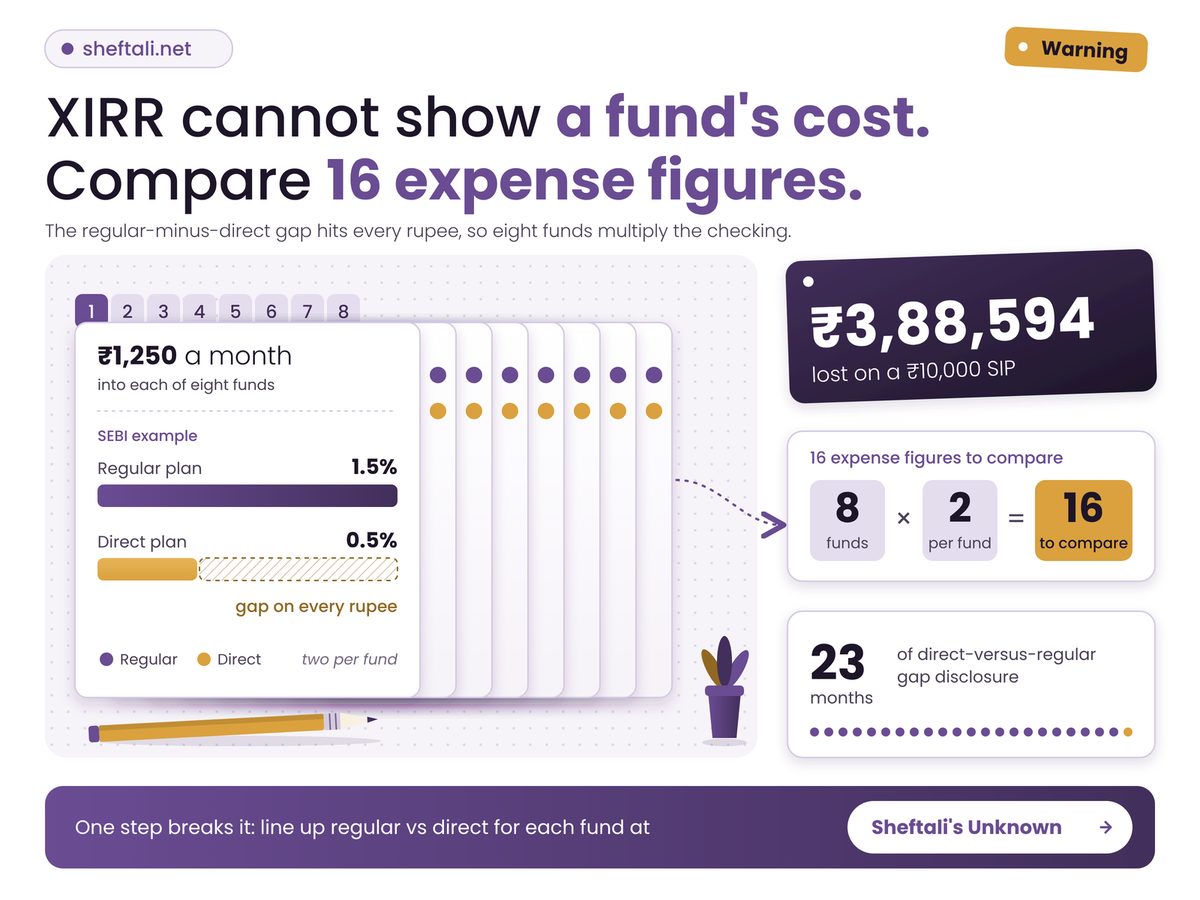
An XIRR headline cannot show what a fund costs, so price each fund before adding the next.
- XIRR comes after a fund's own charges, so a regular plan can look healthy yet trail its direct twin.
- Eight funds add statements to read, not a smaller gap: the difference applies to every rupee.
- Read each fund's regular-minus-direct expense in its half-yearly statement, then use the calculator below.
- Stay regular only if the adviser's service is worth that rupee figure to you.
Why does a SIP XIRR headline hide what eight funds cost?
Because XIRR is calculated after a fund's own charges and only for the window shown, it can look strong while the regular plan's extra commission quietly removes rupees you never see itemised.
XIRR is an annualised rate on dated cash flows, so a SIP that began just before a fall and ended just after a rise prints a splendid number; shift the start date and the same fund prints a poor one. Small repeating charges slip past: the renewal invoice scam works because a repeating amount feels ordinary.
SEBI chose disclosure after the fact. Its circular of 5 November 2024 (SEBI/HO/IMD/PoD1/CIR/P/2024/150, effective 5 December 2024 per Business Standard) makes funds show expenses and half-yearly returns for direct and regular plans separately, because commission cannot be charged to a direct plan. Rules like the auto-renewal disclosure law show the charge before it lands; this one prints it afterwards.
SEBI’s advertisement circular CIR/IMD/DF/23/2017 (as of March 2017) asks for CAGR over 1, 3 and 5 years, a point-to-point result on ₹10,000, and a statement of regular or direct plan. It does not mention SIP returns, so an XIRR headline alone is not that format: ask for the multi-year CAGR of the same scheme and plan beside it. Whether a private deck counts as an advertisement is a grey area; in our view, it should.
AMFI’s August 2026 data, reported by Onmanorama, counts 10.02 crore contributing SIP accounts. SEBI’s investor page (retrieved 1 November 2026) shows a 1.5% regular expense ratio leaving 8.5% of a 10% return, against 9.5% for a 0.5% direct plan. The gap disclosure is about 23 months old, and ₹3.89 lakh is our own sum for a ₹10,000 SIP over 15 years.
Contributing SIP Accounts
10.02 crore
Accounts, not investors
Gap in SEBI's Own Example
1.0 point
Lost yearly on every rupee
Gap Disclosure Age
23 months
Both plans' costs, side by side
Drag on a ₹10,000 SIP
₹3.89 lakh
Derived: 15 years at 12%
A count of accounts is not a count of people: on our reading, one investor running eight SIPs appears as eight. SEBI's example takes the same slice of every rupee in one fund or eight.
Splitting a SIP across eight funds divides your attention, not the cost: the gap travels with every rupee.
How much does the gap cost you on your own SIP?
It costs between roughly ₹0.6 lakh and ₹36 lakh on a ₹10,000 monthly SIP, depending on how many years you hold and how wide your fund's gap is.
Take your holding period and your fund's gap: the regular plan's total recurring expense minus the direct plan's, both in its half-yearly statement. Do that subtraction for one fund now and you have your number in under a minute. The 1.0% column is SEBI's illustrative gap, not a measured average.
Worked example: assume a ₹10,000 SIP paid at the start of each month for 15 years (₹18 lakh paid in), a direct plan earning 12% a year, and a regular plan earning 1.0 point less, 11%. Compounding 180 payments at monthly rates of (1 + r)^(1/12) - 1 gives about ₹47,59,314 in the direct plan and ₹43,70,720 in the regular plan. The difference is ₹3,88,594, or 8.2% of the direct corpus.
Find your years down the side and read across at your gap. Each cell is the rupees lost, in lakh (L), on a ₹10,000 SIP at 12% a year.
| Years held | 0.5% gap | 1.0% gap | 1.5% gap |
|---|---|---|---|
| 10 years | ₹0.6L | ₹1.2L | ₹1.7L |
| 15 years | ₹2.0L | ₹3.9L | ₹5.7L |
| 20 years | ₹5.4L | ₹10.4L | ₹15.2L |
| 25 years | ₹13.0L | ₹24.9L | ₹35.8L |
The shaded cell is the worked example. One step right adds about ₹1.8 lakh at 15 years; one step down adds roughly ₹6.5 lakh at a 1.0% gap. For a ₹20,000 SIP, double any cell.
Splitting one ₹10,000 SIP across eight funds leaves the total cost unchanged and multiplies the checking by eight, so open every statement before adding a fund. Derived from the worked example split into eight equal slices.
Where does the eight-fund pitch break down?
It breaks wherever a fund's extra cost buys nothing you can name, such as holdings that overlap another fund on the list or a performance claim from someone unregistered.
The task scam that pays you a small amount first works because proof arrives before cost; a best-window XIRR is a gentler version. Nothing in the deck is false, or rather, nothing has to be. The window and the plan type are both chosen by whoever is paid if you say yes.
One investor on r/personalfinanceindia wrote in early 2025 of putting over ₹30 lakh into regular-plan SIPs through a broker before learning direct plans exist. Replies split on whether a gap near 1% or a good broker matters more. One post, not a statistic.
Do not borrow a cap as your gap. Since 1 April 2026, SEBI’s mutual fund regulations cap an open-ended equity scheme’s base expense ratio at 2.10% on the first ₹500 crore of assets, per HDFC AMC’s March 2026 notice. It does not say how regular and direct plans share that ceiling, so only your statement gives your gap.
- Overlap: funds in one category can hold the same companies, so a longer list can be one bet paid for twice.
- Registration: SEBI’s January 2025 circular, as summarised by Mondaq, bars unregistered people from promising returns, so ask a reel’s author for a SEBI registration number.
Conditions to check before you add the next fund
- Your statement lists the plan as Regular, not Direct.
- The deck gives an XIRR but no multi-year CAGR for the same scheme and plan.
- Two funds on the list sit in the same category.
- The person recommending cannot say whether the fund house pays them.
This week, open each fund’s latest half-yearly statement, subtract the direct plan’s total recurring expense from the regular plan’s, and enter that gap in the calculator above. The decision is whether to keep each regular-plan SIP or stop it and restart in the direct plan. Selling units you hold can trigger exit load and tax, so read SEBI’s regular-versus-direct page first. If you would otherwise stop investing, a regular plan you keep beats a direct plan you abandon.
How we checked this
We read SEBI’s advertisement circular CIR/IMD/DF/23/2017 (15 March 2017), its circular of 5 November 2024 on expense and half-yearly return disclosure, and its regular-versus-direct page (retrieved 1 November 2026). The worked example assumes a ₹10,000 monthly SIP, 15 years, 12% and 11% yearly returns and payments at month start. AMFI counts come via Onmanorama and the finfluencer rule via Mondaq. No product was tested hands-on for this article, and no fund is recommended.
Last verified: 1 November 2026. Edited by Sheftali, reviewed after publication. Spotted something out of date? Tell us and we will correct it.
No comments
Post a Comment