Friday, August 28, 2026

Surveillance Pricing: How Your Personal Data Quietly Sets Your Price

Your child spikes a fever at eleven at night. You open a retail app, type in baby thermometer, and the first page hands you the expensive ones. Not because they rank better. Because something in the profile attached to your account has decided you are a new parent, awake late, in no position to shop around. The Federal Trade Commission used almost exactly that scenario as its own illustration, which tells you it is not hypothetical.
Surveillance Pricing: How Your Personal Data Quietly Sets Your Price
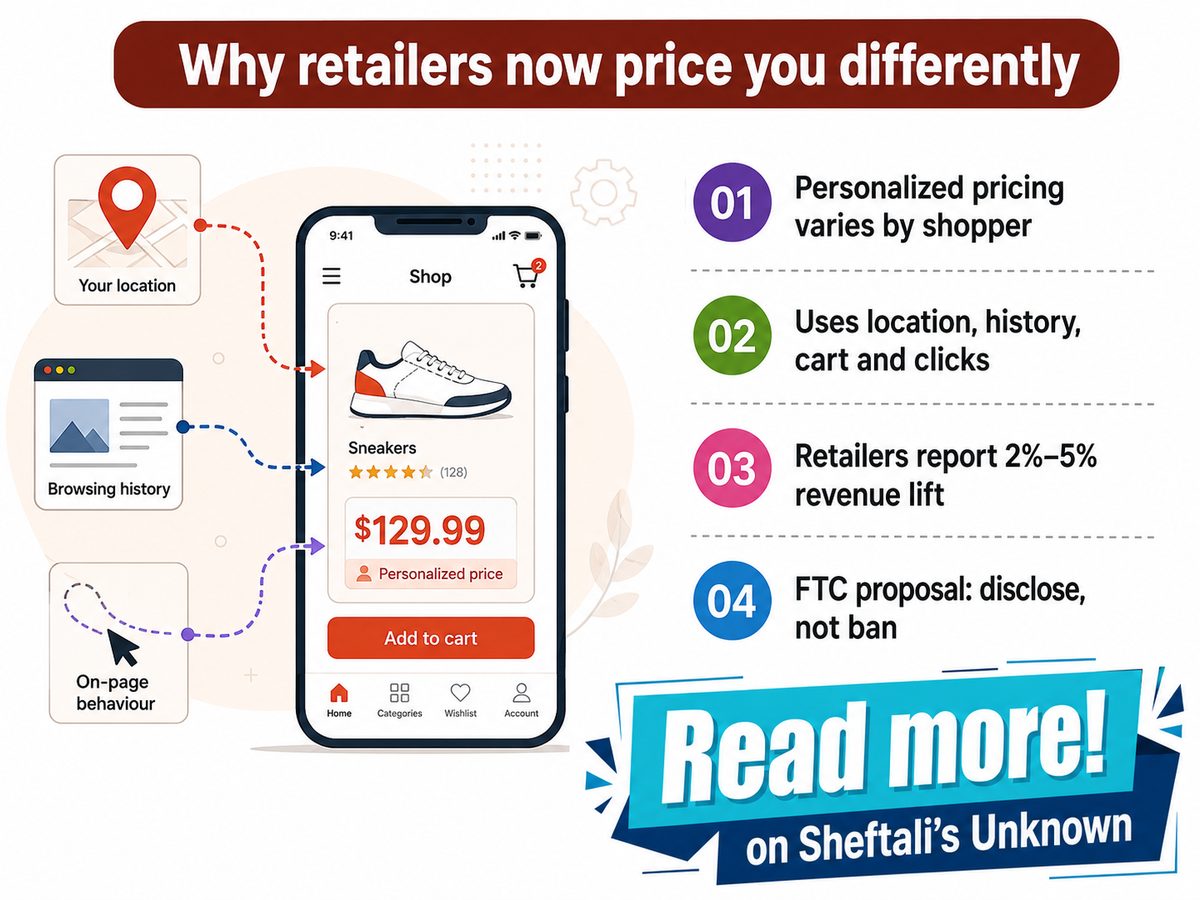
Retailers increasingly set prices per person, using location, browsing history and behaviour on the page. The FTC's proposed policy would force them to say so, name the basis, and list the data used. It stops short of banning the practice. Disclosure is the ceiling, not the fix.

Why It Matters

Start with the distinction the whole thing turns on. Dynamic pricing moves with supply, demand and inventory, and it hits everyone in the market at the same moment. Personalized pricing moves with you. The same product on the same page can carry a different number for you than for the person sitting next to you, because the retailer has built an estimate of what you specifically will tolerate. The first is economics. The second is a guess about your wallet, assembled from data you did not knowingly hand over for that purpose.

And here is the part most of the coverage underplays: the money is not the real injury. A few percent on a thermometer will not ruin anyone. The injury is that you cannot detect it. A shortage you can read about. A surge price announces itself in the checkout screen. A price built quietly from your browsing history looks exactly like an ordinary price tag, which is precisely why it works.

A January 2025 Federal Trade Commission study of six pricing intermediaries, Mastercard and McKinsey among them, documented what actually feeds these systems: precise location, browser and search history, cart abandonment, demographics, purchase history, and mouse movements on the page. Mouse movements. The hesitation before you click is an input. It is the same shape as a vendor rewriting the deal after you have already paid, the pattern behind cloud shutdowns bricking smart home devices you already own, except this one happens before the sale instead of after it.

Four figures explain the shape of the problem better than any argument about fairness does. One is a deadline. One measures who absorbs it hardest. One is scale. One is the reason the industry will fight for it.

Comment Window Closes

18 Sep 2026

Thirty days from proposal

Food Share Of Income

33%

Lower income households, pretax

Retail Clients Reached

250+

Through studied pricing intermediaries

Reported Revenue Lift

2% to 5%

Where personalization is deployed

Take the client reach figure. That is what separates this from a story about two or three technology giants running clever experiments on their own customers. These pricing engines are sold as a service, bolted onto grocery chains and apparel retailers that have never written a line of machine learning in their lives. Your local supermarket does not need a data science team to price you individually. It needs a vendor contract.

"

A low single digit revenue lift is not a rounding error at retail scale. It is the entire reason no chain gives this up until a regulator makes it.

What The Proposal Actually Says

So what does it require, and where does it stop? Here is the whole of it, stripped of the compliance language the law firm client alerts are written in.

Category Detail Insight
Status Proposed enforcement policy under docket FTC-2026-1057, not legislation Guidance with Section 5 teeth behind it
Disclosure Three elements required: personalization stated, its basis, the data types All three, or the disclosure fails
Wording Vague framing such as "specially selected" ruled insufficient Euphemism will not clear the bar
Data In Scope Seven categories named, from precise location to on-page mouse movement Behaviour you never priced yourself against
Exempt Market-wide dynamic pricing carries no disclosure duty at all Surge pricing stays as invisible as before
Safe Harbour One logged-in account's own prior purchases, disclosed accurately and completely Loyalty history is the sanctioned pricing input
Highest Risk Health status, family circumstance or absence of alternatives as inputs Vulnerability targeting draws the first enforcement
Margin Effect Adopters report profit margin gains of 1% to 4% Nobody abandons this without external pressure

Read the safe harbour row twice. If a retailer prices you off your own purchase history on your own logged-in account, and says so plainly, it is compliant. That description covers a very large share of what grocery loyalty programmes already do today, which means the practice most shoppers would object to hardest is also the one most cleanly blessed.

Jul 2024  Aug 2026  2027  1 2 3 Eight pricing firms  ordered to hand over records  Enforcement policy  proposed for public comment  Disclosure expected  to take practical effect 

Three stages in the arc: eight pricing firms were ordered to hand over records in July 2024, the enforcement policy went out for public comment in August 2026, and the disclosure duty is expected to take practical effect in 2027.

Friction Points

The proposal does not ban any of this. It cannot, or rather the FTC says it cannot, reading its own authority as reaching disclosure and stopping there. Chairman Andrew Ferguson framed the expectation plainly: when consumers see a listed price, they expect it to be the same price that everyone else sees, not the retailer's estimate of how much they are willing to pay based on their personal data. That is an accurate description of what shoppers assume. It is not a description of what the policy delivers.

Here is where I part company with the optimistic reading. A disclosure tells you a price was personalized. It does not tell you whether yours is the high one. Without a baseline, without the unpersonalized number sitting beside it for comparison, the label is a weather warning with no temperature attached. My honest view is that this is the unsolved weak point, and the comment docket will not solve it either, because the obvious fix, publishing a reference price alongside the personal one, is the single thing retailers will refuse outright.

None of this is unusual for how consumer terms get rewritten on people quietly. It is the same posture as the way Windows 10 extended security update terms landed without an announcement, changed in place, visible only to whoever went looking. What you can control is your own measurement discipline. Four things are worth watching:

  • Signed in versus signed out. If you only ever see the app's logged-in price, you have never seen the other one.
  • Loyalty cards. The discount is real. So is the profile it builds while you collect it.
  • Location permissions. Precise location sits on the FTC's list of pricing inputs, and most retail apps request it by default.
  • Repeat visits. Cart abandonment is a documented input, so hesitating on a product page is itself a signal you are sending.

Key Takeaways

  • Consumer Reports found Instacart running live price experiments on shoppers who were never told they were part of one.
  • Kroger sorts loyalty members into buckets such as loyal and non-loyal, and those buckets are pricing inputs, not just mailing lists.
  • A price checked while signed in and the same price checked in a private window are two separate measurements. Treat them that way.

Do one thing this week. Pick something you buy on a schedule, check its price signed in on the app, then check it again in a private browser window with location switched off, and write both numbers down. If they match, good, you have a baseline. If they do not, you have learned more about how you are priced than any disclosure label is ever going to tell you. Start measuring now, while the comparison still surprises you.

Thursday, August 20, 2026

Windows 10 Support Extended To 2027: What ESU Actually Covers

Your laptop is fine. It boots fast, the battery still holds a charge, and the only thing wrong with it is a processor that missed Microsoft's Windows 11 eligibility list by about two model years. Last autumn it stopped getting security updates anyway. Then in late June, with no keynote and no email, Microsoft handed it another year.

Windows 10 Support Extended To 2027: What ESU Actually Covers

Microsoft quietly pushed Windows 10 consumer security updates out to October 2027. Three enrollment routes, one of them genuinely free, all delivering identical coverage. It buys critical patches for version 22H2 and nothing else: no features, no technical support. Enroll now, then plan the exit anyway.

The Extra Year Nobody Announced

The extension arrived the way awkward decisions usually do, as an editor's note appended to documentation that was already sitting there. Microsoft's own consumer ESU page now prices the paid route at $30 one time plus tax, and dates the coverage window to 12 October 2027. Anyone who enrolled during the first year was carried across at no extra charge and told nothing. Call it a reprieve. Actually, call it a pressure valve, because that is what it does.

The pressure is real and it is measurable. Windows 11 holds a clear majority of desktops now, but a large minority of the world's PCs are still running the version Microsoft stopped patching for free. Those machines mostly do not belong to holdouts making a point. They belong to people whose hardware failed an eligibility check they had never heard of until a notification told them about it, which is the same pattern that switched off smart home devices their owners had already paid for. And the obvious fix is not cheap, because memory pricing has pushed the cost of a decent new machine well past where it sat two years ago.

Four numbers describe the entire offer. What Microsoft added, what the points route costs, how far a single license stretches, and how much of the world this still applies to.

Extra coverage added

12 months

Deadline moved into 2027

Rewards route price

1,000 points

Redeemed, never purchased

Devices per license

10 PCs

One Microsoft account each

Windows 10 desktop share

29.83%

StatCounter, July 2026

The device count is the number people leave on the table. Enrollment feels like a per-machine chore, so it gets done on the laptop that nagged loudest and forgotten on the desktop in the study and the machine the kids use for homework. A single license stretches across a household's worth of PCs provided they all sign in under the same Microsoft account. That turns the free route into something worth doing deliberately, in one sitting, rather than reactively.

"

Three doors, identical patches behind each one. All that changes is what Microsoft takes at the threshold: your money, your loyalty points, or your settings synced to its cloud.

Which Door To Walk Through

The routes are not equivalent, even though three of them end in exactly the same patch stream. What separates them is what you hand over on the way in, and how easily you can change your mind later.

Dimension Windows Backup route Rewards route Paid route Move to Windows 11
Out of pocket Nothing Nothing, if you already have points A card charge, plus local tax Free upgrade, or a new PC
Real cost Your settings live in OneDrive A balance you cannot spend twice Money, and nothing else Relearning an interface you did not choose
Patch scope Security fixes only, no features Identical to the free route Identical again, minus the cloud trade Full updates, features included
Household reach One license covers the family PCs Same reach, same account rule Same reach, paid once Per machine, judged individually
Reversible Yes, stop syncing later No, spent points stay spent No, treat it as a sunk cost Only inside a short rollback window
Biggest catch Free cloud storage fills quickly Most people have no balance Buys time, solves nothing structural Older CPUs fail the eligibility list
Best suited for Anyone already signed in and syncing Bing and Xbox users with idle points Anyone refusing to sync settings Machines that already pass the check

Read that as a privacy decision rather than a price decision, because on coverage the three ESU columns are indistinguishable. The paid route is the only one that buys patches without handing Microsoft either your synced configuration or your accumulated goodwill, which is a strange thing to have to pay for and, for some readers, still the right call.

1 2 3 4 14 Oct 2025 · Nov 2025 · 25 Jun 2026 · Autumn 2027 · Free support ends · Enrollment opens · Quiet extension · Final patch lands

Two of those four dates were published without an announcement, which tells you how Microsoft expects this transition to be managed: quietly, and by you.

Where This Still Bites

Extended Security Updates is not a support extension, and the naming does a lot of work to hide that. It is a patch drip aimed at one specific build. Microsoft states plainly that enrollment brings critical and important security updates and nothing further: no fixes for bugs that annoy you, no product improvements, no help desk to call when something breaks. If a driver stops working next March, you are on your own with it.

The larger risk sits outside Microsoft's control entirely. Browser makers, GPU driver teams, antivirus vendors and banking apps set their own end-of-support dates, and none of them are obliged to match this one. An operating system that receives patches while the software layered on top quietly stops being tested is only partly protected. Microsoft's household pricing has form for shifting terms mid-stream too, as family plan subscribers discovered when Copilot arrived in their bill. And if you are switching on Windows Backup purely to unlock enrollment, treat it as one layer of a backup plan that can actually survive a dead drive, not the whole of one.

Whether a third year appears is the genuinely open question, and nobody outside Redmond can answer it. My read is that the June extension was a response to adoption numbers that refused to move, which makes another one plausible but not something to bet a household's security on. Treat this as the last cheap year rather than the first of many. That is a stance, not a forecast, and I would happily be wrong about it.

  • Apply the license across every PC in the house in one sitting, not one crisis at a time.
  • Go looking for the enrollment prompt in Windows Update rather than waiting for it to find you.
  • Treat the account you enroll with as permanent, because unpicking it later reopens the whole question.
  • Put the decision date in your calendar for spring 2027, not autumn, since autumn reminders get snoozed.

Enrollment blockers worth checking first

A child account will not enroll. The Microsoft account has to be administrator level on that machine.

Work laptops joined to a domain, to Entra, or managed through MDM sit outside the consumer program, with a narrow carve-out for Entra-registered devices.

The PC must already be on version 22H2 with current updates installed before the option appears at all.

Enroll this week, on every machine in the house, through whichever door you can live with. Then open your calendar and book a real decision for spring, because a year of borrowed patches is not a plan and the clock started in June without asking you.

Saturday, August 1, 2026

Cloud Shutdowns Are Bricking Smart Home Devices You Already Own

The plug still clicks. The hardware in the wall works exactly as well as it did the day it shipped, the relay closes, the light comes on if you press the button with your thumb. What stopped working was permission. A server in someone else's building got switched off, and the thing you paid for quietly demoted itself to a switch you have to walk across the room to reach.

Cloud Shutdowns Are Bricking Smart Home Devices You Already Own

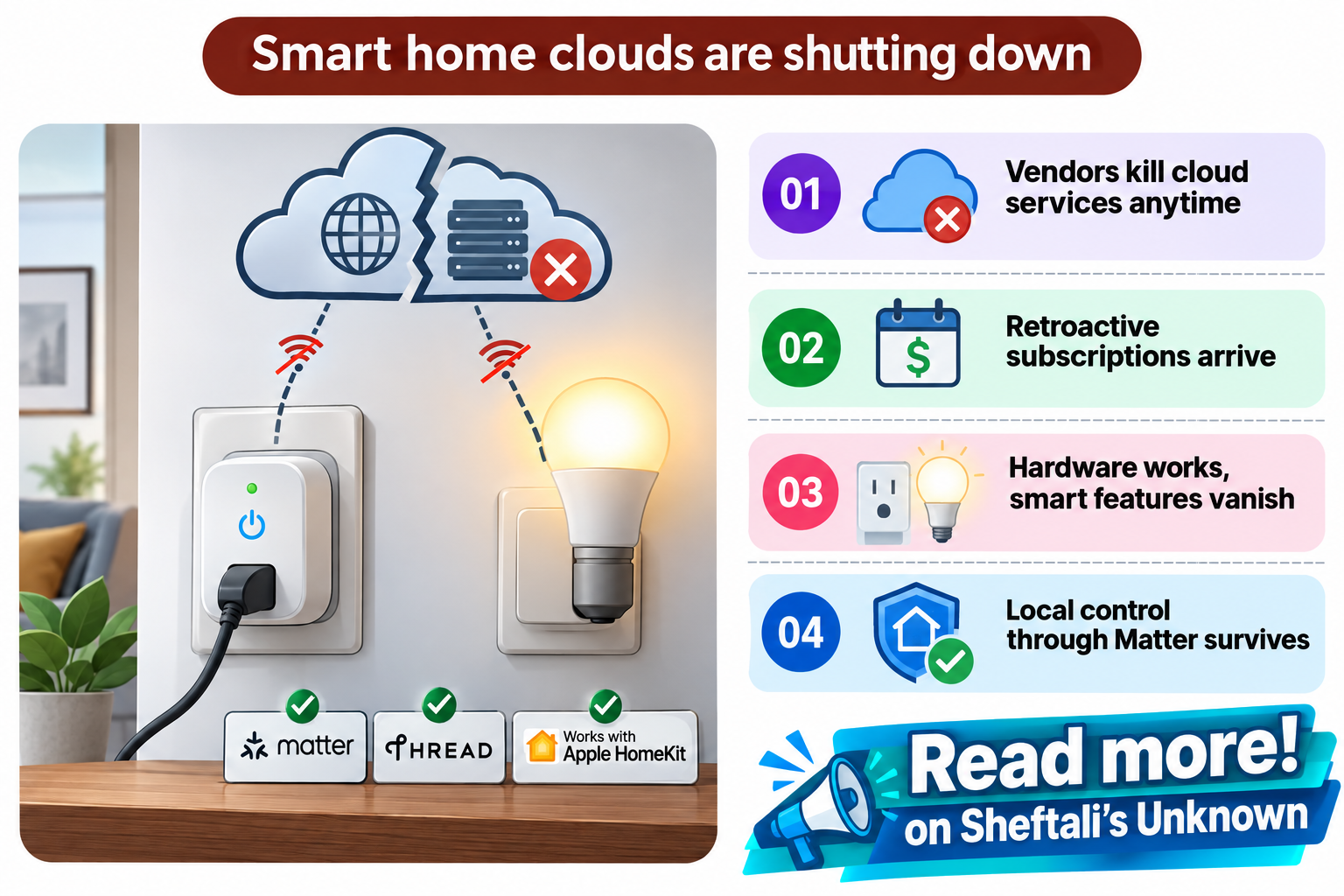
Smart home makers are shutting down clouds and adding retroactive subscriptions to hardware people already bought. Devices keep their physical function and lose everything else. Local control through Matter, Thread or HomeKit is currently the only protection that survives a vendor decision.

Why Your Own Hardware Stopped Answering

Belkin ended cloud services and app support for most Wemo products on 31 January 2026. Plugs, wall switches, bulbs, baby monitors, motion sensors: all still drawing power, none of them answering Alexa or Google any more, remote access gone. Belkin gave notice and offered refunds on units still under warranty. By the standards of this pattern that counts as the polite version.

The impolite version is Futurehome. The Norwegian company filed for bankruptcy on 20 May 2025, and the entity that picked up the platform put a mandatory annual fee on roughly 30,000 Smarthub II owners who had already bought their hardware outright. Refuse to pay and a firmware update strips out local network functions. Not a fee for a new service. A fee to keep the thing you own doing what it did last Tuesday.

And this is where I part company with the standard advice, which is to buy big brands because they will still be around. Belkin is a big brand, owned by Foxconn. Size did not save Wemo owners, because what killed those devices was not a solvency decision, it was a margin decision, and large companies make those faster than small ones. The same logic showed up when Microsoft locked Copilot to the account holder on a family plan: nothing broke, someone simply decided who was allowed through the door. Hardware now answers to the same reasoning, except the door is in your hallway.

Wemo Cloud Cutoff

31 Jan 2026

Announced the previous July

Futurehome Annual Fee

$117

Charged on hardware already owned

Hub Owners Affected

30,000

Smarthub II customers in Norway

Cloud-Dependent Share

62.6%

Of the 2025 device market

The fee is the number worth sitting with. It buys nothing new: it is rent, applied after the sale, on a device whose purchase price already covered the hardware. Once one vendor proves a firmware push can convert a paid product into a subscription, trying it becomes a boardroom question rather than a legal one. Anyone comparing smart home gear on sticker price alone is reading half the invoice, roughly the mistake buyers made during the memory shortage that pushed device prices up.

A $117 annual fee on hardware someone already bought outright is not a price increase. It is rent, invented after the sale, collected on a device that used to work for free.

Not every device dies the same way, and the differences are the whole game. Some Wemo units survived the shutdown untouched, purely because of how they were paired before the deadline. The table below separates what the vendor can revoke from what it cannot.

Category Detail Why It Matters
Vendor App First thing switched off Never the basis of a purchase
Voice Control Alexa and Google links break too Both route through the vendor cloud
HomeKit Pairing Wemo units paired early kept working Control never left the house
Thread Support Matter-capable models unaffected Open standard, no vendor gatekeeper
Warranty Status Refunds offered on in-warranty units Only recourse most owners had
Physical Switch Keeps working regardless All you truly bought outright

Read the right-hand column top to bottom and one line separates the survivors from the casualties: whether control ever had to leave the building. Everything routed through a company's servers died on schedule. Everything that spoke locally carried on without noticing.

May 2025 Jun 2025 Jul 2025 Nov 2025 Bankruptcy filed Firmware paywall live Wemo end-of-life news Matter 1.5 ships

Six months took the pattern from one bankrupt vendor to a household name, while the open standard that undercuts it finally added cameras and closures.

Where The Obvious Advice Falls Apart

"Just buy Matter devices" is the answer everyone reaches for, and it is directionally right and practically incomplete. Plenty of hardware carries a Matter badge and still routes the interesting parts, the automations, the history, the notifications, through the manufacturer's cloud. Matter guarantees you can switch the thing on and off locally. It does not guarantee the product you shopped for keeps existing.

There is a real grey area here that nobody has settled. When a company goes bankrupt, no one is obliged to keep servers running for hardware sold by a business that no longer exists, and someone has to pay for that infrastructure. But Futurehome's successor did not shut the lights off, it kept them on and billed for them, which is a different act entirely. Where the line sits between genuine cost recovery and a hostage situation is a question courts have barely started on. Worth remembering that Insteon simply vanished in 2022 with no notice, the version where nobody bills you and nobody helps you either.

Most of the practical failures are avoidable at the point of purchase rather than afterwards. Same discipline that separates a real backup from a hopeful one, covered in the case for moving off fragile drives: assume the convenient path will fail and check what remains. Cheap gear fails this test hardest, its own version of the slide in everyday product quality.

  • Pair every device to a local platform on day one. Wemo owners who linked to Apple Home before the deadline kept control; the ones who waited got no second chance.
  • Treat the vendor's own app as disposable. If a device only works properly through it, you are renting the hardware on a lease with no stated end date.
  • Check whether automations run on a hub in your house or a server somewhere else. That detail alone decides what survives a shutdown notice.
  • Keep the receipt. Refund eligibility during the Wemo wind-down turned entirely on warranty status, and most owners found out too late.

What Actually Survived

Wemo hardware paired with Apple HomeKit before the January cutoff kept operating through the Apple Home app, vendor cloud entirely gone.

Wemo models supporting Thread over Matter were untouched, because that standard is not owned by the company that made the device.

Insteon's 2022 disappearance came with no notice, no refund path and no local fallback. Still the worst case every buyer should price in.

Go and open whatever smart home app you use, right now, and find out which of your devices still work if that app stops existing tonight. Anything that fails the test either gets paired to a local platform this week or gets treated as a purchase with an expiry date the seller has not told you yet. Buy the next one on that basis and the question stops mattering.